

Over the years, I have answered thousands of questions about piles from patients at Karachi Piles Clinic, through WhatsApp, and from people who message me online. I decided to compile the most common, most important ones here — in one place. Think of this as your complete reference guide for any piles-related question you might have.
This piles FAQ page covers every common question about hemorrhoids in one place.
I have tried to answer each one the same way I would answer a patient sitting across from me — honestly, simply, without unnecessary medical jargon.
Basic Questions About Piles
Who gets piles?
Anyone can get piles — men, women, young, old. But the highest risk groups are: people over 50 years old, pregnant women, people with chronic constipation or diarrhea, those with low fiber diet, people who sit for long hours, and those with a family history of piles.
Will piles go away by themselves?
Grade 1 piles sometimes resolve on their own with dietary changes. Grade 2 — possible but unlikely without some treatment. Grade 3 and 4 — no, these will not go away on their own and will typically worsen with time.
How long do piles last?
Mild Grade 1 piles with proper diet may improve in 4-6 weeks. Without treatment, moderate to severe piles become chronic and last indefinitely — often worsening over time.
Which piles is more painful — internal or external?
External piles are generally more painful because they are under the skin which has more pain nerve endings. Internal piles are often painless but bleed more. The exception is thrombosed external hemorrhoids — these are extremely painful.
Are piles contagious?
No. Piles is not an infection and cannot be passed from one person to another. It is a structural vascular condition caused by increased pressure on anal veins.
Is piles genetic?
There is a genetic component — vein wall weakness and susceptibility can run in families. But genetics alone does not cause piles. Lifestyle and diet factors are the main triggers.
Treatment Questions
When should I see a doctor for piles?
See a doctor if you have: any rectal bleeding (even small amounts), a lump around the anus, pain during or after bowel movements, or something prolapsing out. Also see a doctor if symptoms have not improved after 2 weeks of dietary changes.
Can piles be treated without surgery?
Yes, for Grade 1-2. Diet, fiber, medication, band ligation, and laser treatment are all non-surgical or minimally invasive options. Grade 3-4 usually requires some form of procedure but laser is minimally invasive with no cuts or stitches.
Is laser surgery safe for piles?
Yes — laser hemorrhoidoplasty is a well-established, safe procedure. I have performed it on hundreds of patients at Karachi Piles Clinic. Minimally invasive, same-day discharge, very low complication rate, success rate above 95%.
How long does laser piles surgery take?
The procedure itself takes 20-45 minutes. You arrive at the clinic, get prepared, procedure is done, you rest for 1-2 hours, then go home. Most patients return to desk work within 2-3 days.
Can piles come back after laser treatment?
Recurrence is possible but uncommon — below 5% with proper post-treatment habits. Maintaining high fiber diet and avoiding straining dramatically reduces the chance of recurrence.
What happens if piles is left untreated?
Grade 1-2 may progress to Grade 3-4. Chronic bleeding can cause anemia. Prolapsed piles can become strangulated — a painful emergency. Also, ongoing rectal bleeding that is assumed to be piles might actually be something else that is going undiagnosed.
Lifestyle and Diet Questions
Which doctor treats piles in Karachi?
A proctologist or colorectal surgeon. I am Dr. Abdullah Iqbal — MBBS, FCPS, Pakistan’s first laser proctologist — at Karachi Piles Clinic. We specialize exclusively in piles, fissure, fistula, and related conditions.
Can stress cause piles?
Indirectly yes. Stress often worsens bowel habits — causing either constipation or diarrhea — both of which aggravate piles. Stress management is therefore part of holistic piles management.
How much water should I drink for piles?
8-10 glasses of plain water daily. In Karachi’s summer heat, possibly more. Water works with fiber to soften stool — one without the other is much less effective.
How do piles feel like?
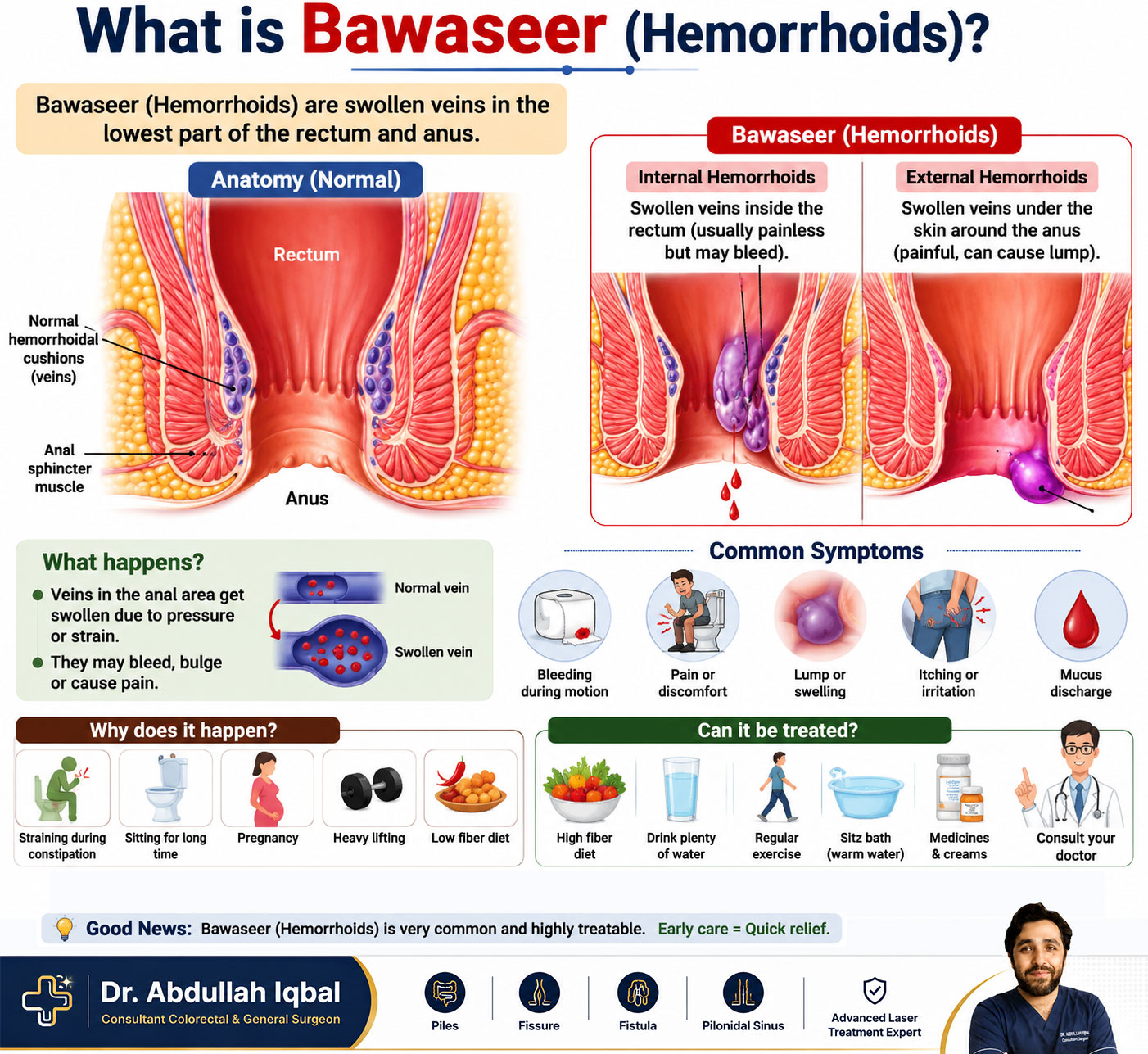
Internal piles are often painless — you may only notice bleeding. External piles feel like a soft lump around the anus that may be tender. Prolapsed piles create a sensation of something coming out. Thrombosed piles are very painful, constant, and tender to touch.
Piles mein exercise kar sakte hain?
Haan — moderate exercise is actually beneficial. Walking, swimming, light yoga all help improve bowel regularity. Heavy weightlifting and cycling can aggravate piles — avoid or reduce these during active symptoms.
Emergency Questions
Piles mein kab emergency mein jana chahiye?
Emergency room mein jayen agar: bleeding nahi ruk rahi, extreme pain jo tolerable nahi, prolapsed pile strangulated ho gayi ho (kali ya dark purple and very painful), ya bhar fever ke saath rectal symptoms hoon.
Kya piles se anemia ho sakti hai?
Haan — chronic low-grade bleeding from piles can cause iron deficiency anemia over time. This is more common than people realize. If you feel weak or tired alongside piles symptoms, get a blood count done.
More questions? Browse our other detailed articles: Piles grades guide, Is piles curable?, Can piles cause cancer?. Or visit us at Karachi Piles Clinic for a personal consultation.
Related reading
- Anal Bleeding: 6 Asal Wajahen Jo Aapko Pata Hona Zaruri Hai
- Piles Cure in 3 Days: What You Need to Know
- Can Piles Cause Cancer? Bawaseer Se Cancer Ho Sakta Hai?
- Khooni Aur Badi Bawaseer – Difference, Symptoms and Right Treatment
- Piles Pictures — Bawaseer Kaisi Dikhti Hai? (Visual Grade Guide)
- piles treatment in Karachi
- Anal fissure laser treatment
- Fistula treatment
- Consult Dr. Abdullah Iqbal

- Fissure Cream vs Laser Treatment — Which One Actually Works? - June 29, 2026
- Fissure During Pregnancy — Safe Treatment Options and What to Avoid - June 22, 2026
- Going to the Washroom with Fissure — 7 Tips That Actually Reduce Pain - June 15, 2026
