MBBS · FCPS · Internationally Trained · ESCP · ASCRS Member • 13,000+ Patients Treated • Same-Day Discharge • Hill Park General Hospital
Hernia Surgery in Karachi — Open Mesh Repair by Dr. Abdullah Iqbal (FCPS)
Last updated: October 5, 2026 · Reviewed by Dr. Abdullah Iqbal, MBBS, FCPS
Book a Direct Consultation with Dr. Abdullah Iqbal
Speak directly with Dr. Abdullah Iqbal. No third-party booking platforms.
Your information is confidential and used only to schedule your consultation. See our Privacy Policy.
Prefer to talk now? 0333-2877351 • WhatsApp
How is hernia mesh repair surgery done in Karachi?
Hernia mesh repair is a surgical procedure where the weakened abdominal wall is reinforced with a synthetic mesh to prevent the hernia from recurring. Dr. Abdullah Iqbal (FCPS General Surgery) performs open mesh repair for inguinal, umbilical, and incisional hernias at Hill Park General Hospital, Karachi. The procedure costs PKR 120,000–150,000 with a recovery period of 2–3 weeks.
Hernia Surgery in Karachi — Open Mesh Repair by Dr. Abdullah Iqbal (FCPS)
If you have noticed a bulge in your groin, belly button, or at the site of an old surgical scar — and it becomes more prominent when you cough, strain, or lift something heavy — you very likely have a hernia. I am Dr. Abdullah Iqbal, a Consultant General Surgeon with FCPS certification and 13+ years of surgical experience. I perform open hernia repair with mesh at Hill Park General Hospital, Karachi, and I want to be upfront: hernia surgery, when done properly, is one of the most straightforward and satisfying operations in general surgery.
Mein hernia ke operations apni practice ka ek bunyadi hissa samajhta hoon — yeh woh surgery hai jo agar sahi tareeqe se ki jaye to patient usi din ya aglay din ghar ja sakta hai aur 7-10 din mein normal zindagi shuru kar sakta hai.
I also run the Karachi Piles Clinic — Pakistan’s first dedicated laser proctology centre — but hernia repair has been at the core of my general surgery training since my FCPS residency at Jinnah Postgraduate Medical Centre. I have personally repaired hundreds of hernias — inguinal, umbilical, incisional, and paraumbilical — and I want to share what I explain to my patients during consultation.
Quick Facts — Hernia Surgery at Karachi Piles Clinic
| Procedure | Open Hernia Repair with Prolene Mesh |
| Surgeon | Dr. Abdullah Iqbal — MBBS, FCPS (General Surgery) |
| Location | Karachi Piles Clinic |
| Cost | PKR 100,000 – 150,000 (all-inclusive) |
| Anaesthesia | Spinal / General (depending on hernia type) |
| Duration | 45–75 minutes |
| Discharge | Same-day or next morning |
| Recovery | Most patients resume normal activities within 7–10 days |
| OPD Days | Tuesday, Thursday, Saturday — 5:00 PM to 8:00 PM |
What Is a Hernia? (Hernia Kya Hota Hai?)
A hernia occurs when an internal organ — usually a loop of intestine or a piece of fatty tissue — pushes through a weak spot in the surrounding muscle or connective tissue (fascia). The result is a visible bulge or swelling that you can often see and feel under the skin.
I explain it to my patients very simply: imagine a tyre with a weak spot in the rubber. When pressure builds up, the inner tube pushes through that weak spot and creates a bulge. That is exactly what happens with a hernia — the abdominal wall has a weak point, and the contents inside push through it.
Hernia asal mein pait ki deewaar mein ek kamzor jagah hoti hai jahan se andar ka hissa — aam taur par aant ka ek hissa ya charbi — bahar ko nikal aata hai. Yeh ek ubhar (bulge) ki shakal mein nazar aata hai jo khansi ya bhaari cheez uthane par zyada hota hai.
Hernias do not heal on their own. I want to be very clear about this because I see patients every month who have been wearing hernia belts (trusses) for years, hoping the hernia will close. It will not. A hernia can only get bigger with time. The only definitive treatment is surgical repair.
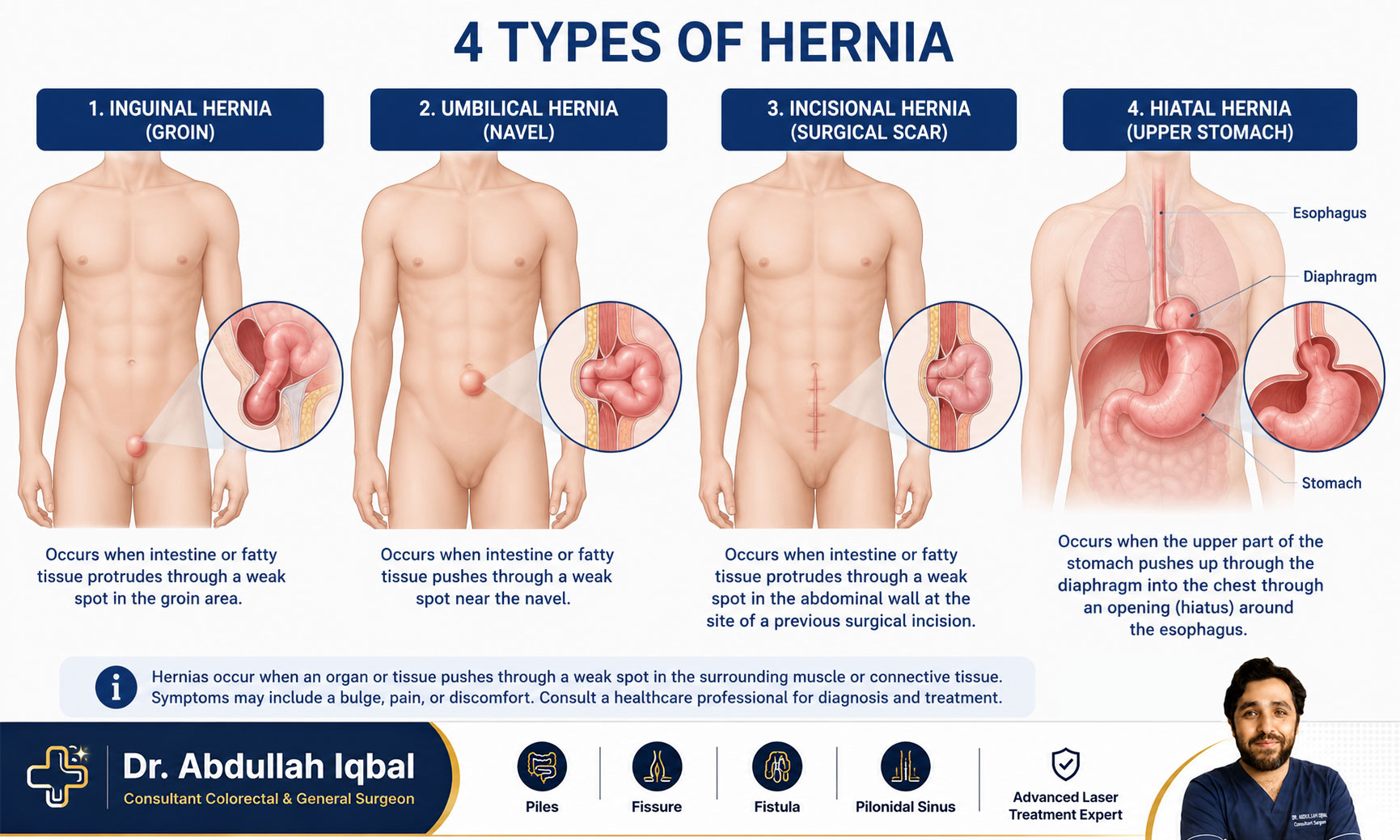
Types of Hernia I Treat
In my practice in Karachi, these are the hernias I see and repair most frequently:
Inguinal hernia (haraniya): This is by far the most common hernia — roughly 70% of all hernias I treat. It occurs in the groin area, where the inguinal canal runs. Men are far more commonly affected than women (approximately 8:1 in my experience). You will notice a bulge in the groin that appears when standing or coughing and may disappear when lying down. I repair inguinal hernias using the Lichtenstein tension-free mesh repair — the gold standard open technique with the lowest recurrence rate.
Umbilical hernia (naaf ka hernia): This hernia develops at or near the belly button. I see it commonly in women — especially those who have had multiple pregnancies — and in overweight patients. In children, small umbilical hernias often close on their own by age 3–4. In adults, they do not close spontaneously and I always recommend surgical repair.
Paraumbilical hernia: Similar to umbilical, but the defect is just above or below the belly button rather than directly at it. This is an important distinction because paraumbilical hernias have a higher risk of strangulation in my experience, and I tend to recommend earlier surgical intervention.
Incisional hernia: This develops at the site of a previous surgical incision — typically after an open abdominal surgery (appendectomy, caesarean section, or any midline laparotomy). The scar tissue is weaker than the original muscle, and a hernia can develop months or even years after the original operation. I see these regularly and they can range from small to very large, sometimes requiring a complex repair with large mesh.
Epigastric hernia: A small hernia in the midline of the upper abdomen, between the belly button and the chest. Usually contains a small piece of fatty tissue. These are typically small but can be quite painful.
How Do You Know You Have a Hernia? — Symptoms
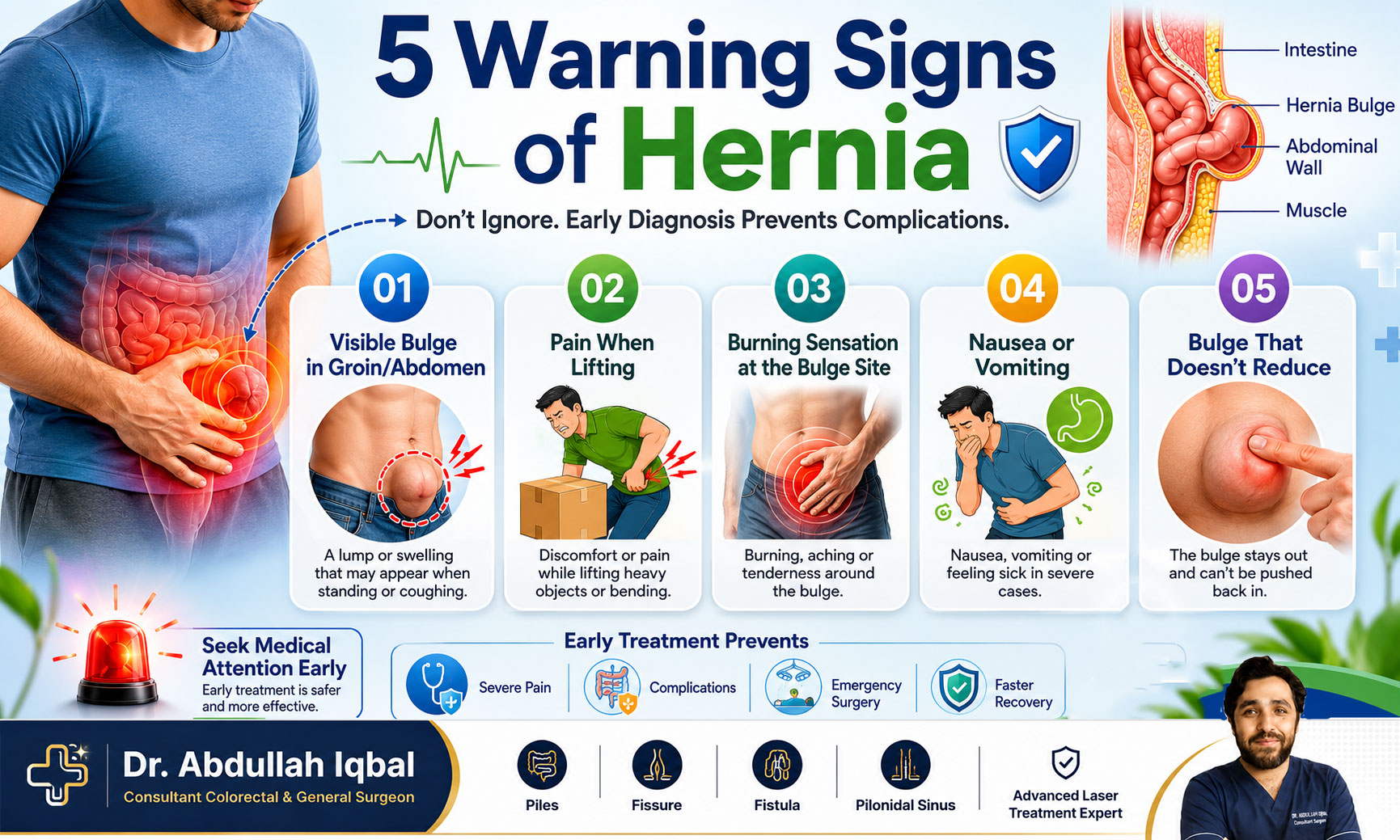
Most of my patients come to me because they noticed a swelling or bulge. But not all hernias are obvious. Here is what I tell patients to watch for:
- Visible bulge (ubhar): In the groin, at the belly button, or along an old scar. It may get bigger when you stand, cough, or strain, and may reduce when you lie flat.
- Aching or dragging sensation: Many patients describe a dull, heavy feeling at the hernia site, especially after standing for long periods or after physical activity.
- Pain when lifting, coughing, or straining: This is a very common complaint — the hernia site hurts with any activity that increases abdominal pressure.
- A burning or sharp pain at the site: This can indicate that the hernia is becoming incarcerated (trapped), which is a warning sign.
- Nausea, vomiting, and inability to pass stool or gas: This is a surgical emergency. It means the hernia is likely strangulated — the trapped intestine has lost its blood supply. If you experience this, go to the emergency room immediately.
Mein apne patients ko hamesha kehta hoon: agar aapko groin ya naaf ke paas koi ubhar nazar aaye jo khansi ya zor lagane par barhta ho — toh woh hernia ho sakta hai. Doctor se zaroor milein, chahe dard na bhi ho.
Open Hernia Repair — How I Perform the Surgery
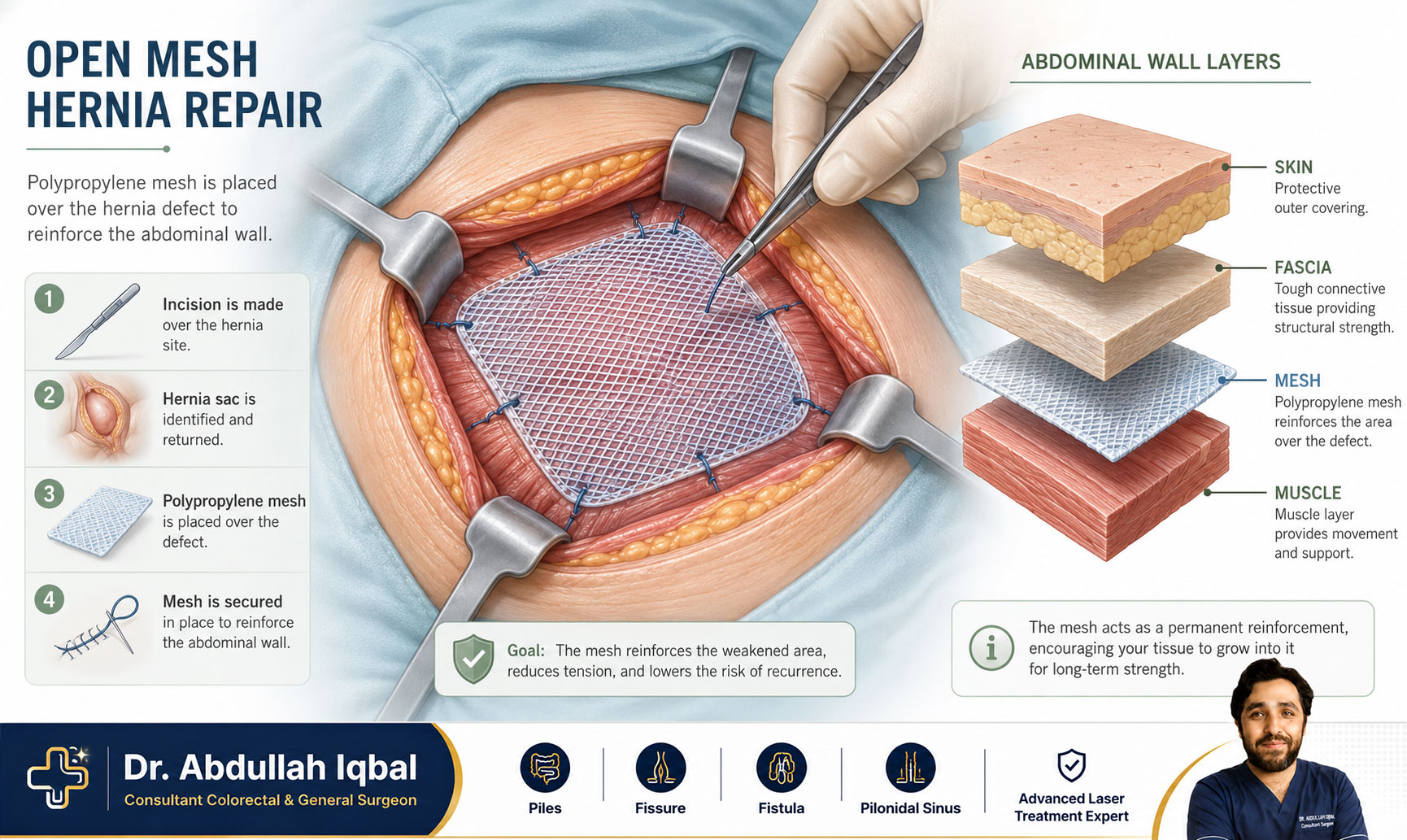
I perform open mesh repair for hernias. Let me explain my approach clearly, because I believe patients deserve to know exactly what will happen:
For inguinal hernia (Lichtenstein repair):
- Anaesthesia: I typically use spinal anaesthesia for inguinal hernias. You are awake but feel absolutely nothing below the waist. In some cases — particularly for elderly patients or those who prefer it — I can perform the repair under local anaesthesia with sedation. General anaesthesia is used when clinically indicated.
- Incision: A single incision of approximately 6–8cm along the natural skin crease in the groin. I am careful to place it in the crease so the scar is cosmetically acceptable.
- Identification: I identify the hernia sac, the spermatic cord structures (in males), and the inguinal floor. The sac is carefully dissected, its contents reduced back into the abdomen, and the sac is either inverted or excised.
- Mesh placement: A polypropylene (Prolene) mesh is placed over the weakened inguinal floor and sutured in place. This is the Lichtenstein tension-free technique — it reinforces the area without putting tension on the tissues, which is why the recurrence rate is very low (under 1% in experienced hands).
- Closure: The wound is closed in layers with absorbable sutures and covered with a waterproof dressing.
For umbilical / incisional hernias: The principle is the same — I identify the defect, reduce the contents, place a mesh to reinforce the repair, and close the wound. Larger incisional hernias may require a wider mesh and sometimes a drain for 24–48 hours.
Total procedure time: 45–75 minutes depending on hernia size and complexity. Straightforward inguinal hernias are typically done in under an hour.
Open Mesh Repair vs Suture-Only Repair — Comparison
Some patients ask me why I use mesh. The answer is simple: evidence and experience. Here is how the two approaches compare:
| Factor | Open Mesh Repair (Lichtenstein) ✅ | Suture-Only Repair (Bassini/Shouldice) |
|---|---|---|
| Recurrence Rate | Under 1% | 5–15% (significantly higher) |
| Technique | Tension-free — mesh bridges the defect | Tension repair — tissues pulled together with sutures |
| Post-Op Pain | Less — no tension on tissues | More — tissues are pulled tight |
| Recovery Time | 7–10 days to normal activities | Similar, but more discomfort initially |
| Suitable For | All adult inguinal, umbilical, incisional hernias | Very small hernias, paediatric cases |
| International Standard | Gold standard recommended by European Hernia Society | Largely replaced by mesh repair in modern surgery |
| Cost at KPC | PKR 100,000 – 150,000 | Slightly lower but higher recurrence cost long-term |
I want to address a common concern: some patients worry about mesh causing problems. In my experience, modern polypropylene mesh is extremely well-tolerated by the body. It integrates into the tissue within a few weeks and becomes part of your abdominal wall. Mesh-related complications — such as chronic pain or infection — are rare (under 1%) when the surgery is performed by an experienced surgeon in a clean operating environment.
Recovery After Hernia Surgery — What to Expect
Day of surgery: Most of my patients are walking within 4–6 hours after spinal anaesthesia wears off. I encourage early walking — it reduces the risk of blood clots and speeds recovery. Many patients go home the same evening. If the surgery was done under general anaesthesia or the hernia was large, I keep them overnight.
Days 1–3: Some soreness and swelling at the incision site is normal. I prescribe oral painkillers — typically paracetamol and a mild anti-inflammatory. The pain is very manageable. I advise patients to avoid straining, heavy lifting, and any activity that increases abdominal pressure.
Days 3–7: Gradual improvement. Light walking, eating normally, taking care of personal hygiene — all fine. The wound is covered with a waterproof dressing so you can shower normally.
Day 7–10: I see patients for a follow-up visit. Most are ready to resume office work, light daily activities, and driving. The sutures are absorbable and do not need removal.
Weeks 3–4: I allow return to moderate physical activity. No heavy lifting (over 10 kg) for 6 weeks.
6 weeks: Full recovery. No restrictions. You can return to gym, sports, and heavy physical work.
Hernia Surgery Cost in Karachi — 2026 Updated
I believe in price transparency. Here is exactly what hernia surgery costs at my practice:
Open Hernia Repair with Mesh at Karachi Piles Clinic:
PKR 100,000 – 150,000
This includes surgeon’s fee, anaesthesia, OT charges, mesh cost, hospital stay (same-day or one night), medicines, and follow-up visit. Final cost depends on hernia type, size, and complexity — confirmed after clinical examination.
Hernia ke operation ki mukammal laagat PKR 100,000 se 150,000 tak hai — jis mein surgeon ki fees, behoshi ki dawai, operation theatre, mesh, hospital stay, adwiyaat aur follow-up visit sab shamil hai. Koi hidden charges nahi hain.
My consultation fee is PKR 2,000. During consultation, I examine the hernia, assess its type and size, check for any complications, and give you a definite cost with no hidden charges.
Watch Dr. Abdullah Iqbal Explain Hernia Surgery
Dr. Abdullah Iqbal explains hernia surgery — types, technique, and what to expect — in Urdu. Subscribe to the channel for more educational videos.
Can a Hernia Be Treated Without Surgery?
This is a question I get asked almost daily. I am always honest: no, a hernia cannot heal on its own. There is no medicine, exercise, or hernia belt that will close a hernia.
Hernia belts (trusses) can temporarily push the hernia back and reduce discomfort, but they do not fix the underlying defect. I have seen patients wear belts for 5–10 years, only to come for surgery when the hernia has grown much larger and the repair has become more complex. My advice: if you have a hernia, get it repaired while it is still small. Small hernias are easier to repair, have faster recovery, and carry lower risk.
The only exception is very small, asymptomatic hernias in elderly patients with significant medical problems where the surgical risk outweighs the benefit. In those rare cases, I advise watchful waiting with regular follow-up.
When Is Hernia Surgery an Emergency?
Most hernia repairs are elective — you plan the surgery at your convenience. But two situations are emergencies:
Incarcerated hernia: The hernia contents (usually intestine) get trapped and cannot be pushed back. The hernia becomes hard, painful, and tender. This needs urgent surgery — usually within hours.
Strangulated hernia: This is a true surgical emergency. The trapped intestine loses its blood supply. The patient develops severe pain, nausea, vomiting, fever, and may stop passing stool or gas. If not operated on promptly, the intestine can die (gangrene), requiring bowel resection — a much bigger and more dangerous operation.
I have operated on strangulated hernias in the middle of the night. The outcome is always worse than a planned, elective repair. This is why I tell every hernia patient: do not wait until it becomes an emergency.
Why Choose Dr. Abdullah Iqbal for Hernia Surgery in Karachi?
- FCPS-certified General Surgeon — the highest surgical qualification from CPSP
- 13+ years of surgical experience — trained at Jinnah Postgraduate Medical Centre, one of Pakistan’s premier surgical training institutions
- Hundreds of hernia repairs performed — inguinal, umbilical, incisional, paraumbilical, and complex recurrent hernias
- Lichtenstein tension-free mesh repair — the internationally recommended gold standard technique
- Hill Park General Hospital — centrally located on Shaheed-e-Millat Road with fully equipped OT and ICU backup
- Transparent pricing: PKR 100,000–150,000 all-inclusive, no hidden charges
- Same-day discharge for most patients
- Direct WhatsApp access — I personally respond to patient queries before and after surgery
- Also specialises in laser proctology — if you also have piles, fissure, or fistula, both can be discussed in a single consultation at Karachi Piles Clinic
Hernia Consultation — WhatsApp for Appointment
Share your symptoms or ultrasound report on WhatsApp. OPD: Tue, Thu, Sat — 5–8 PM.
Frequently Asked Questions — Hernia Surgery in Karachi
Medical Disclaimer: This content is for informational purposes only and does not replace professional medical advice. Every patient’s condition is different — please consult Dr. Abdullah Iqbal directly for an assessment specific to your case. Last updated: May 2026.