
MBBS · FCPS · Internationally Trained · ESCP · ASCRS Member • 13,000+ Patients Treated • Same-Day Discharge • Hill Park General Hospital
Gallbladder Stone Surgery in Karachi — Laparoscopic Cholecystectomy by Dr. Abdullah Iqbal
Last updated: October 21, 2024 · Reviewed by Dr. Abdullah Iqbal, MBBS, FCPS
Book a Direct Consultation with Dr. Abdullah Iqbal
Speak directly with Dr. Abdullah Iqbal. No third-party booking platforms.
Your information is confidential and used only to schedule your consultation. See our Privacy Policy.
Prefer to talk now? 0333-2877351 • WhatsApp
What is laparoscopic gallbladder surgery and what does it cost in Karachi?
Laparoscopic cholecystectomy is the standard treatment for gallbladder stones — the gallbladder is removed through 3–4 small cuts using a camera and surgical instruments. Dr. Abdullah Iqbal (FCPS General Surgery) performs this procedure at Hill Park General Hospital, Karachi. Cost ranges from PKR 130,000–150,000, with a 1-day hospital stay and 5–7 day recovery.
Gallbladder Stone Surgery in Karachi — Laparoscopic Cholecystectomy by Dr. Abdullah Iqbal
If you have been diagnosed with gallbladder stones (pitte ki pathri) and your doctor has recommended surgery, I understand how overwhelming that feels. I am Dr. Abdullah Iqbal — a Consultant General Surgeon with FCPS certification from CPSP and 13+ years of surgical experience. I perform laparoscopic cholecystectomy at Hill Park General Hospital, Karachi, and in my experience, this is one of the safest, most predictable surgeries in modern medicine.
Mein har hafte gallbladder ke mutaadid operation karta hoon — aur mein aitemaad se keh sakta hoon ke laparoscopic cholecystectomy aaj kal ek bilkul mehfooz aur aazmooda tareeqa ilaj hai.
I also run the Karachi Piles Clinic — Pakistan’s first dedicated laser proctology centre — but gallbladder surgery has been a core part of my surgical practice since my training days at JPMC. I have personally performed hundreds of laparoscopic cholecystectomies, and I want to share what I tell my patients during consultation.
Quick Facts — Gallbladder Surgery at Karachi Piles Clinic
| Procedure | Laparoscopic Cholecystectomy |
| Surgeon | Dr. Abdullah Iqbal — MBBS, FCPS (General Surgery) |
| Location | Karachi Piles Clinic |
| Cost | PKR 130,000 – 150,000 (all-inclusive) |
| Duration | 30–45 minutes |
| Discharge | Same-day or next morning |
| Recovery | Most patients resume normal activities within 5–7 days |
| OPD Days | Tuesday, Thursday, Saturday — 5:00 PM to 8:00 PM |
What Are Gallbladder Stones? (Pitte Ki Pathri Kya Hoti Hai?)
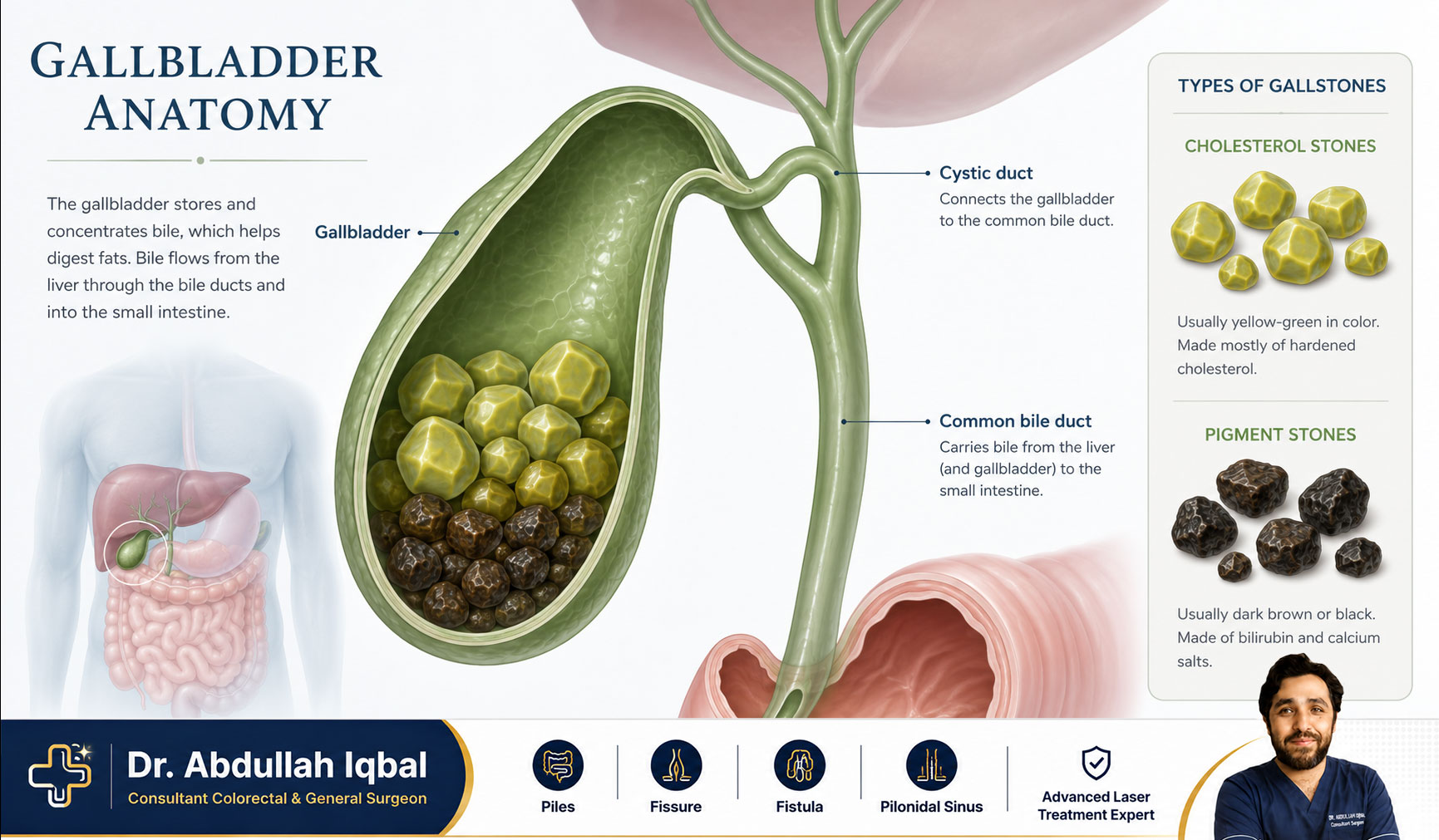
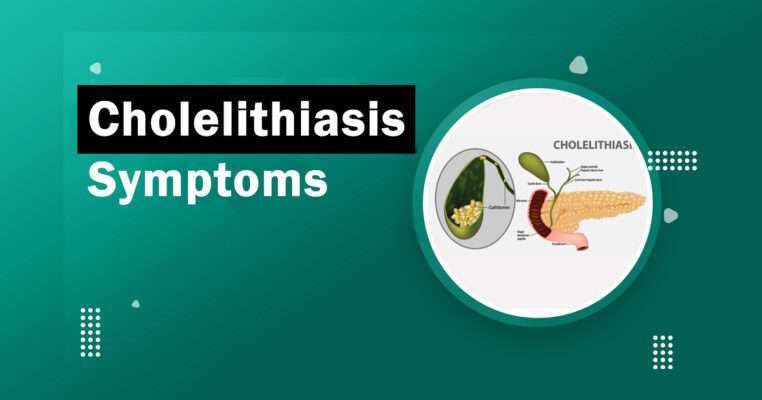
Gallbladder stones — medically known as cholelithiasis — are hardened deposits of bile that form inside your gallbladder. The gallbladder (pitta) is a small, pear-shaped organ sitting just below your liver. Its job is to store bile, a digestive fluid your liver produces to help break down fats.
In my clinic, I see patients every week who have been living with gallstones for months, sometimes years, because they did not realise what was causing their symptoms. Here is what happens: when bile becomes too concentrated, or when there is an imbalance in the chemicals that make up bile — particularly cholesterol and bilirubin — stones begin to form. These can be as small as a grain of sand or as large as a golf ball.
Pitte ki pathri banne ki sab se aam wajah cholesterol ki zyadti hai. Khaas taur par khawateen, 40 saal se zyada umar ke log, aur zyada wazan walay afraad mein ye masla aam hai.
I always explain to my patients that gallstones are extremely common in Pakistan. Our dietary habits — heavy use of cooking oils, fried foods, high-carb meals — combined with genetic factors make Pakistani women particularly susceptible. In fact, I see more female patients for gallstones than male, roughly in a 3:1 ratio.
Gallbladder Stone Symptoms — How Do You Know You Have Gallstones?
Many patients come to me after enduring months of vague abdominal discomfort that they attributed to “gas” or “acidity.” I understand — the symptoms can be confusing. But here are the signs I tell my patients to watch for:
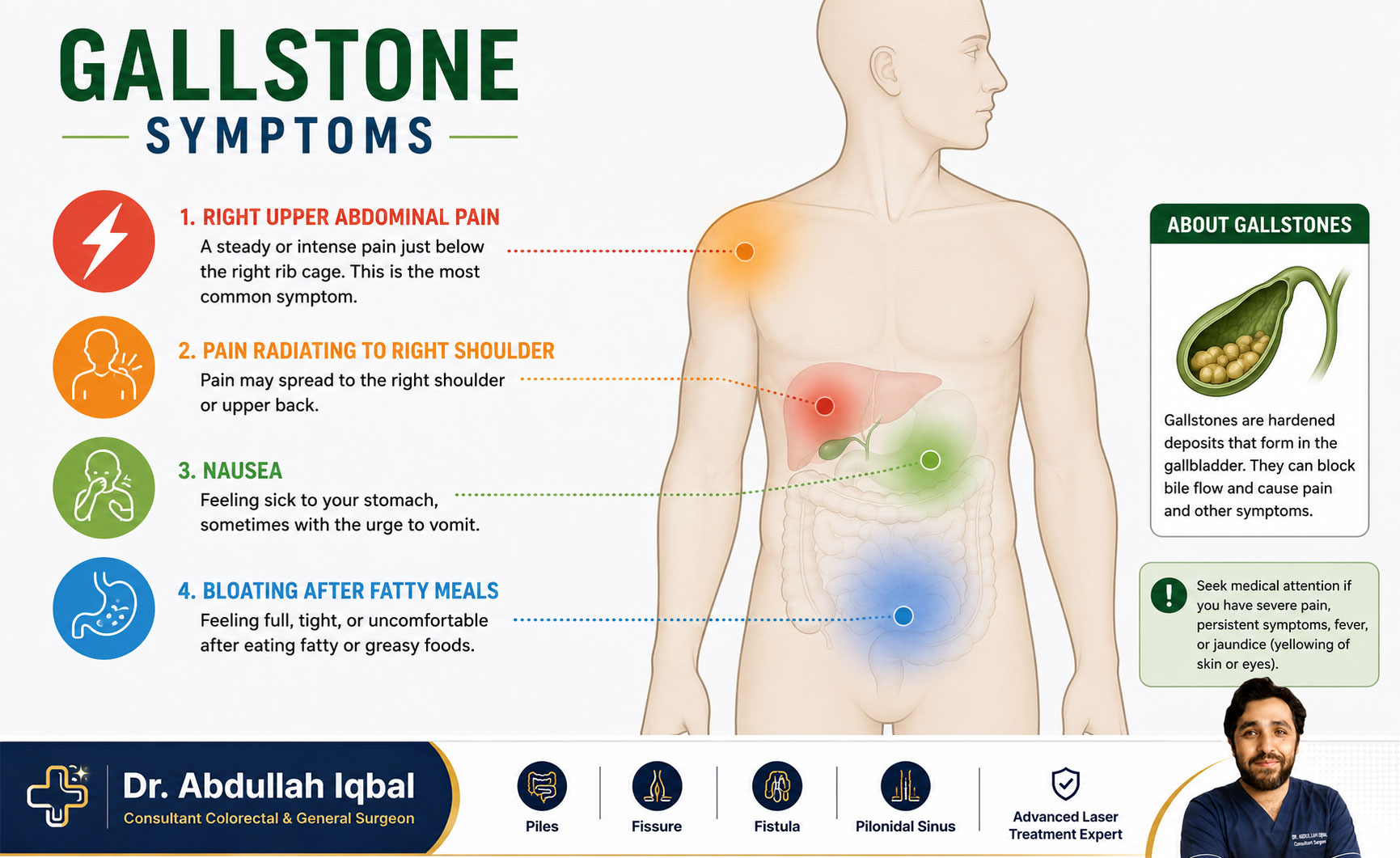
- Right upper abdominal pain (daayen taraf pait mein dard): This is the hallmark symptom. The pain is typically sharp, comes in waves, and often strikes 30–60 minutes after a fatty meal. I describe it to patients as a “squeezing” sensation just below the right rib cage.
- Pain radiating to the right shoulder or back: This is a classic referred pain pattern. If you feel abdominal pain that shoots to your right shoulder blade — this is very characteristic of gallstones.
- Nausea and vomiting after eating: Especially after oily, greasy, or heavy meals. Many of my patients tell me they stopped eating biryani or fried foods entirely because it triggers pain.
- Bloating and indigestion (pait phoolna): A persistent feeling of heaviness, particularly after meals.
- Jaundice (yarqaan): If a stone migrates into the common bile duct (CBD), it can block bile flow and cause yellowing of the skin and eyes. This is an emergency — I always tell patients that if they notice yellow eyes with fever, they must come to the hospital immediately.
- Fever with chills: This may indicate cholecystitis (gallbladder infection) or cholangitis (bile duct infection) — both are serious complications that need urgent intervention.
I want to be very clear here: not all gallstones cause symptoms. I see patients whose stones are discovered accidentally during an abdominal ultrasound done for another reason entirely. In my professional opinion, if stones are silent and causing no symptoms, I do not recommend surgery immediately. I observe them. But the moment symptoms begin — particularly recurrent biliary colic — I believe surgery is the right path.
When Does a Gallbladder Need to Be Removed? — My Approach
This is the question I hear most often: “Doctor sahab, kya operation zaroori hai? Kya dawai se nahi ho sakta?”
I am always honest with my patients. There is no reliable medicine that permanently dissolves gallstones. Some doctors prescribe ursodeoxycholic acid (UDCA), and while it may slow stone growth in certain cases, in my experience, it rarely eliminates stones completely — and once you stop the medication, stones often return.
I recommend surgery when:
- You have had one or more episodes of biliary colic (the classic right-sided pain after meals)
- Ultrasound shows multiple small stones — these carry a higher risk of migrating into the bile duct
- You have had acute cholecystitis (gallbladder infection)
- There is a stone in the common bile duct (CBD stone) — this is an emergency indication
- You have gallstone pancreatitis — a serious complication where a stone blocks the pancreatic duct
- You are a diabetic patient with symptomatic gallstones — I tend to recommend earlier surgery for diabetics because complications in this group are more severe
Laparoscopic Cholecystectomy — The Gold Standard Procedure
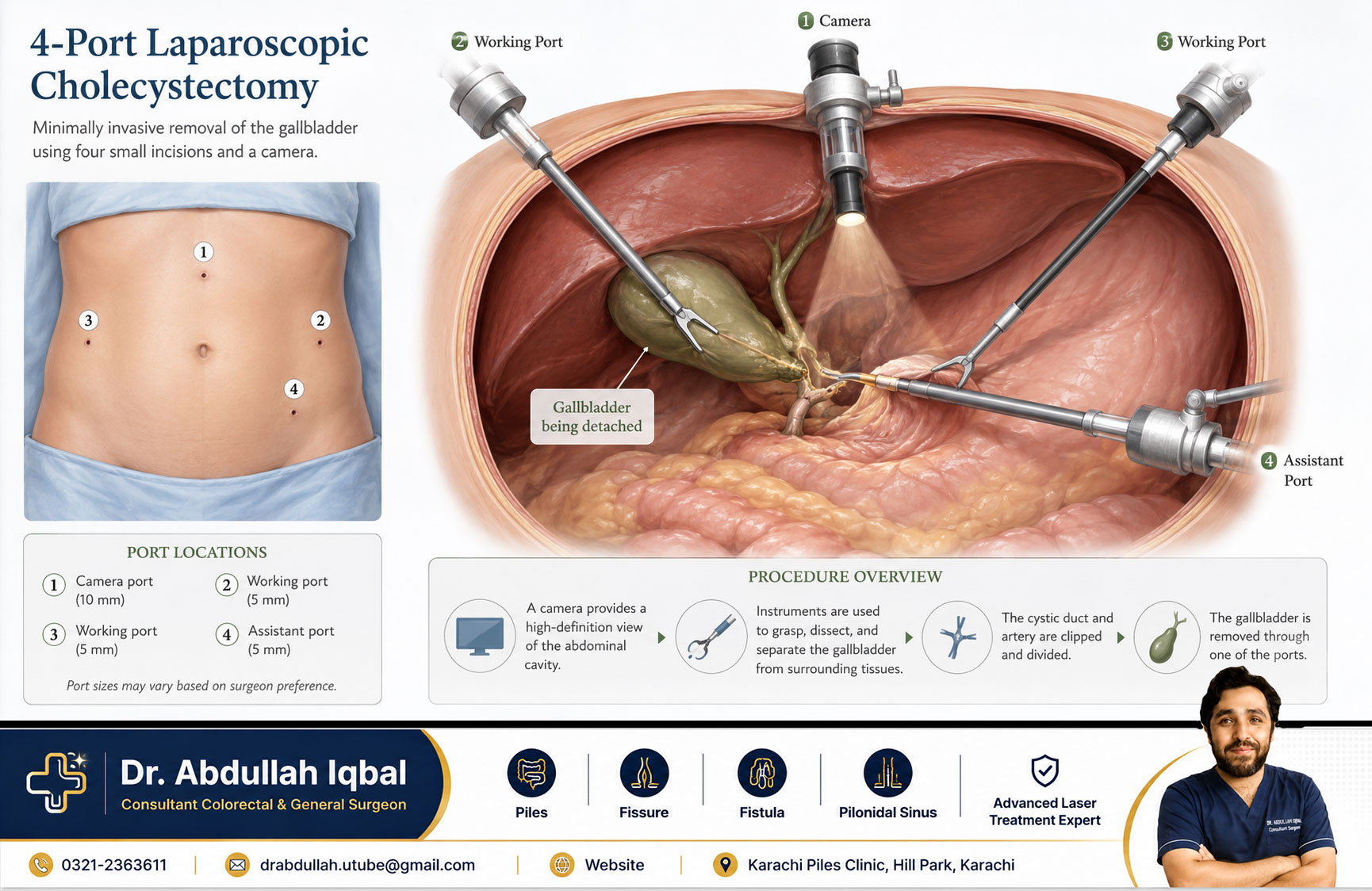
I perform laparoscopic cholecystectomy — a keyhole surgery where the entire gallbladder is removed through 3–4 tiny incisions (each 5–10mm). This is the gold standard worldwide, and I have been performing this procedure since my training at Jinnah Postgraduate Medical Centre.
Here is exactly how I do it:
- General anaesthesia: You are completely asleep. You feel nothing during the procedure.
- Four small incisions: I make four tiny cuts — one at the navel (belly button), one below the xiphoid process, and two on the right side of the abdomen.
- CO₂ insufflation: I inflate the abdomen with carbon dioxide gas to create a working space and improve visibility.
- Camera insertion: A high-definition laparoscope (camera) goes through the navel port, giving me a magnified view of the gallbladder and surrounding structures on a screen.
- Critical View of Safety (CVS): This is something I am very particular about. Before clipping anything, I meticulously identify the cystic duct and cystic artery in the Calot’s triangle. I never clip until I am 100% certain of the anatomy. This step is what separates a safe cholecystectomy from a dangerous one.
- Clipping and division: Once CVS is achieved, I clip the cystic duct and cystic artery with titanium clips and divide them.
- Gallbladder removal: The gallbladder is dissected off the liver bed using electrocautery and extracted through the navel incision in a retrieval bag.
- Closure: The small incisions are closed with absorbable sutures and covered with waterproof dressings.
Total procedure time: 30–45 minutes in a straightforward case. I have completed many cases in under 30 minutes, though I never rush — patient safety always comes first.
Laparoscopic vs Open Gallbladder Surgery — Comparison
I believe every patient deserves to understand why I recommend laparoscopic over open surgery. Here is a direct comparison based on my own surgical experience:
| Factor | Laparoscopic Cholecystectomy ✅ | Open Cholecystectomy |
|---|---|---|
| Incision Size | 3–4 cuts, each 5–10mm | One large cut, 12–15cm |
| Anaesthesia | General anaesthesia | General anaesthesia |
| Procedure Time | 30–45 minutes | 60–90 minutes |
| Hospital Stay | Same-day or 1 night | 3–5 days |
| Post-Op Pain | Mild, manageable with oral painkillers | Moderate to severe, injectable painkillers needed |
| Recovery Time | 5–7 days to resume normal activities | 4–6 weeks |
| Scarring | Minimal — nearly invisible after healing | Visible scar on right side of abdomen |
| Infection Risk | Very low | Higher due to larger wound |
| Cost at KPC | PKR 130,000 – 150,000 | Varies — often comparable but longer stay adds cost |
I want to be honest here: open surgery is not a bad operation. I have performed many open cholecystectomies myself — particularly in cases where severe inflammation or dense adhesions make laparoscopic access unsafe. A good surgeon knows when to convert from laparoscopic to open. I never hesitate to convert if patient safety demands it. But in my experience, the vast majority of gallbladder cases — over 95% — can be completed laparoscopically.
What Happens After Gallbladder Surgery? — Recovery Guide
This is something I discuss with every patient before surgery because managing expectations is part of my responsibility.
Day of surgery: Most of my patients are awake, alert, and walking within 4–6 hours of the procedure. Many go home the same evening. Some prefer to stay overnight, and I always leave that choice to the patient.
First 2–3 days: You will feel some soreness around the incision sites. Some patients experience mild shoulder tip pain — this is caused by the residual CO₂ gas irritating the diaphragm. It resolves on its own within 24–48 hours. I prescribe oral painkillers (usually paracetamol + a mild anti-inflammatory).
Days 3–5: Most patients feel significantly better. Light walking is encouraged. Avoid lifting heavy objects (anything over 5 kg) for 2 weeks.
Day 7: Most of my patients resume their normal routine — office work, driving, household activities. I see them for a follow-up visit at this point to check the wound sites.
Diet after surgery: I always advise patients to start with a low-fat, light diet for the first 2 weeks. Your body needs time to adjust to bile flowing directly from the liver into the intestine without the gallbladder acting as a reservoir. Avoid heavy oils, red meat, and excessively greasy foods initially. Within 3–4 weeks, most patients return to a normal diet without any issues.
Gallbladder Surgery Cost in Karachi — 2026 Updated
I believe in complete price transparency. Too many patients in Karachi waste weeks calling different hospitals and getting vague answers about cost. Here is exactly what you can expect:
Laparoscopic Cholecystectomy at Karachi Piles Clinic:
PKR 130,000 – 150,000
This includes surgeon’s fee, anaesthesia, OT charges, hospital stay (same-day or one night), medicines, and follow-up visit. Final cost depends on the complexity of the case, confirmed after clinical assessment and ultrasound review.
Operation ki mukammal laagat PKR 130,000 se 150,000 tak hai — jis mein surgeon ki fees, behoshi ki dawai, operation theatre ke akhrajaat, hospital ka qayam, adwiyaat aur follow-up visit sab shamil hai.
My consultation fee is PKR 2,000. During the consultation, I review your ultrasound report, assess the severity of your condition, and give you a clear plan — including a definite cost figure with no hidden charges.
Watch Dr. Abdullah Iqbal Explain Gallbladder Stones
Dr. Abdullah Iqbal explains gallbladder stones — symptoms, complications, and treatment options — in Urdu. Subscribe to the channel for more educational videos.
Can Gallbladder Stones Be Treated Without Surgery?
This is perhaps the most common question I get — and I always give a straight answer.
No medicine permanently removes gallstones. I have seen patients come to me after trying homeopathic remedies, herbal “liver cleanses,” and various desi totke for months or years. By the time they finally come for surgery, many have developed complications that could have been avoided.
That said, I do not believe every gallstone needs surgery. My approach is:
- Silent gallstones with no symptoms: I observe. Yearly ultrasound follow-up. No surgery needed unless symptoms develop.
- Single episode of mild colic: I counsel the patient on dietary modification. If it happens again, I recommend surgery.
- Recurrent symptoms, multiple stones, or any complication: Surgery. Delaying at this point only increases risk.
I always tell my patients: the gallbladder is not an essential organ. Your body functions perfectly well without it. The liver continues to produce bile — it simply flows directly into the intestine instead of being stored. Most patients notice no dietary difference after 3–4 weeks.
Risk Factors — Who Gets Gallstones?
In my practice, I have noticed clear patterns. The medical literature describes the “5 Fs” — and I find this to be remarkably accurate in my Karachi patient population:
- Female: Women are 2–3 times more likely to develop gallstones, especially during pregnancy and with oral contraceptive use
- Forty: Risk increases significantly after age 40
- Fat: Obesity and a high-cholesterol diet are major risk factors
- Fertile: Multiple pregnancies increase risk due to hormonal changes
- Fair: While this refers to Caucasian populations in Western literature, I find it less relevant in our population — Pakistani women across all skin tones develop gallstones frequently
Additional risk factors I frequently see in my Karachi patients: diabetes, rapid weight loss (crash dieting), family history of gallstones, and a sedentary lifestyle.
Complications of Untreated Gallstones
I do not say this to frighten anyone — I say it because I have treated these emergencies and I know how preventable they are:
- Acute cholecystitis: The gallbladder becomes infected and inflamed. This is a surgical emergency — the patient presents with severe right-sided pain, fever, and tenderness. I have operated on patients at 2 AM for this condition.
- Choledocholithiasis (CBD stone): A stone migrates from the gallbladder into the common bile duct, blocking bile flow. This causes jaundice and can lead to cholangitis — a life-threatening infection.
- Gallstone pancreatitis: One of the most serious complications. A small stone blocks the pancreatic duct, causing acute pancreatitis. I have seen patients in ICU for weeks because of this.
- Empyema of gallbladder: The gallbladder fills with pus. This requires emergency surgery and can be dangerous if it ruptures.
- Gallbladder perforation: Rare but life-threatening. The inflamed gallbladder wall breaks down, leading to peritonitis.
The message I always give my patients: elective surgery is always safer than emergency surgery. When you plan the operation, you are in the best condition — fasting, prepared, calm. In an emergency, the surgery is harder, the risks are higher, and the recovery is longer.
Why Choose Dr. Abdullah Iqbal for Gallbladder Surgery in Karachi?
- FCPS-certified General Surgeon — postgraduate qualification from the College of Physicians and Surgeons Pakistan (CPSP), the highest surgical qualification in the country
- 13+ years of surgical experience — trained at Jinnah Postgraduate Medical Centre, one of Pakistan’s busiest surgical training hospitals
- Hundreds of laparoscopic cholecystectomies performed — including complex cases with acute cholecystitis, dense adhesions, and Mirizzi syndrome
- Hill Park General Hospital — a well-equipped, centrally located hospital on Shaheed-e-Millat Road with modern OT facilities and ICU backup
- Transparent pricing — PKR 130,000–150,000 all-inclusive. No hidden charges
- Same-day discharge for most patients
- Direct surgeon access via WhatsApp — I personally respond to patient queries before and after surgery
- Also specialises in laser proctology — if you have co-existing piles, fissure, or fistula, both conditions can be discussed in a single consultation at Karachi Piles Clinic
Gallbladder Consultation — WhatsApp for Appointment
Send your ultrasound report on WhatsApp for a preliminary assessment. OPD: Tue, Thu, Sat — 5–8 PM.
Happy Patient Reviews

Haseeb Khan
Assalam Walekum, my father’s operation was done two weeks ago by Dr. Abdullah which is absolutely fine Alhumdulillah. All the doctors had refused the operation because my father had suffered brain hemorrhage 2 years ago. Dr. Abdullah is such a nice person by his nature and he is an excellent gallbladder surgeon.

Gohar Ali
I would like to share a review of my excellent experience with Dr Abdullah Iqbal who performed my gallbladder surgery. I felt safe, all the staff were very professional, and everyone took care of me.

Adeel Shazad
During my year in Karachi, I was impressed by the excellent, affordable gallbladder surgery. Despite the low cost, the care was professional and reliable. I highly recommend Dr. Abdullah Iqbal.

Hamza Siddique
I had gallbladder operation recently with Dr. Abdullah Iqbal and I must say he is an excellent gallbladder surgeon in Karachi. I am very pleased with the outcome.

Junaid Kamal
By the grace of Almighty Allah and professionally tackled by Dr Abdullah Iqbal — my father is Alhamdulillah fine and back to normal life after gallbladder surgery conducted on 12th Dec 2024.

Tariq Ishaq
I had a great experience with Dr. Abdullah — very cooperative and kind towards his patients. He did my gallbladder operation on 6 September 2024 and I am fully satisfied.
Frequently Asked Questions — Gallbladder Surgery in Karachi
Medical Disclaimer: This content is for informational purposes only and does not replace professional medical advice. Every patient’s condition is different — please consult Dr. Abdullah Iqbal directly for an assessment specific to your case. Last updated: May 2026.
Related Articles
Read more about gallbladder conditions, surgery, and recovery from Dr. Abdullah Iqbal.

Explore Our Gallbladder Guides
- 5 Pitte Ki Pathri Ki Alamat (Pitte Ki Pathri Ki Alamat)
- Cholelithiasis Meaning in Urdu — Gallbladder Stone Complete Guide
- Gallstone Surgery — When Is It Safe?
- Gallstones Dietary Advice — What to Eat Before & After Surgery
- Pitta Organ in English — Gallbladder Function Explained
- Gallbladder Cancer Ki Alamaat, Wajoohat Aur Ibtidaai Tashkhees
- Gallbladder Cancer Ka Ilaj: Surgery, Chemotherapy Aur Tareeqay