

If you have an anal fissure, I know what your biggest fear is — going to the washroom. I have seen patients who literally avoid eating just to delay their next bowel movement. That sharp, burning pain during and after passing stool can make you dread something that should be completely natural. But avoiding food only makes things worse — constipation leads to harder stool, which tears the wound open again.
In my practice at Hill Park General Hospital, I share very specific practical tips with every fissure patient. These are not generic advice from the internet — these are steps that I have seen work in real clinical outcomes, reducing pain significantly within the first week.
Tip 1: Use a Stool Softener Before Your Bowel Movement
The single most important thing you can do is ensure your stool is soft. Hard stool is the enemy of fissure healing. I advise my patients to take Ispaghol (psyllium husk) — one tablespoon mixed in a glass of water, taken at night before sleeping. By morning, the stool passes much more smoothly. According to Mayo Clinic, fiber supplements are the first-line recommendation for fissure management.
Ispaghol raat ko lein, subah aaram se farigh hoon. This one habit alone reduces pain by 50% in most patients I see.
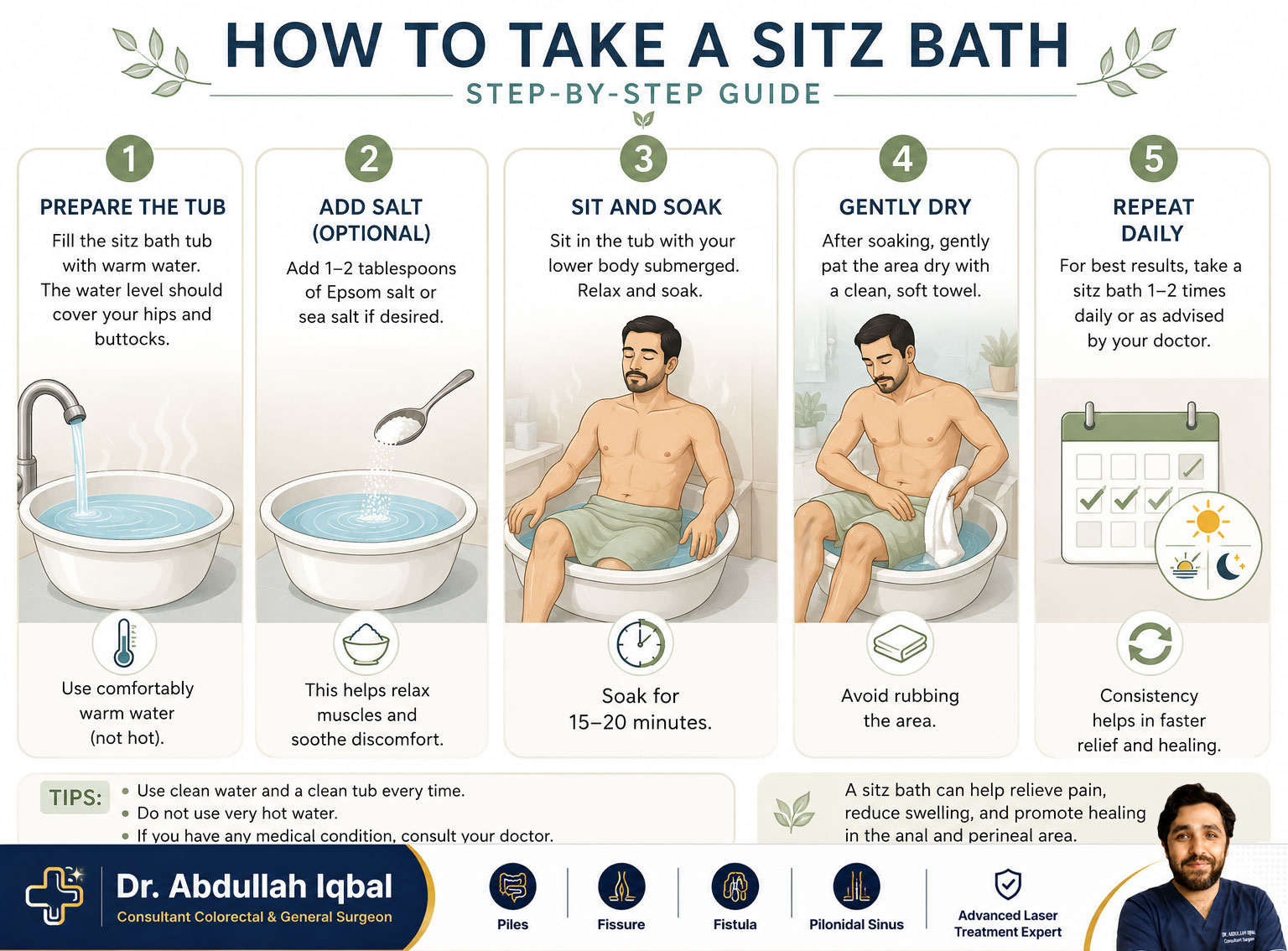
Tip 2: Take a Warm Sitz Bath Before Going
Most people take a sitz bath after the washroom. I suggest doing it before as well. Sitting in warm water for 10 minutes relaxes the sphincter muscle and improves blood flow to the area. When the muscle is relaxed, stool passes with less pressure on the tear. You do not need any special equipment — a clean plastic tub with warm water works perfectly.
Tip 3: Apply a Topical Numbing Cream 15 Minutes Before
I prescribe a topical lidocaine-based cream or ointment to many of my fissure patients. Applied 15 minutes before your expected bowel movement, it numbs the area and significantly reduces the sharp pain during passing. Yeh cream sirf doctor ki advice se lagayein — do not self-medicate with random ointments from the pharmacy.
Tip 4: Do Not Strain — Ever
Straining is the worst thing you can do with a fissure. If stool does not come naturally within 5 minutes, get up and try again later. I have seen patients who push hard because they want to “get it over with” — but straining increases pressure on the tear, causes more bleeding, and delays healing. According to the NHS UK, avoiding straining is a key part of fissure treatment.
Tip 5: Use Water Instead of Toilet Paper
Dry toilet paper scrapes against the fissure and causes irritation. I strongly suggest using a handheld bidet (Muslim shower / health faucet) or simply pouring warm water while cleaning. Pat dry gently with a soft cloth afterwards — do not rub. This is one area where our Pakistani hygiene habits actually work in our favour.
Tip 6: Adopt the Squatting Position
The modern sitting toilet puts your body at the wrong angle. Your puborectalis muscle stays partially tightened, meaning you have to push harder. A squatting position naturally relaxes this muscle. If you use a western-style toilet, place a small stool (6-8 inches high) under your feet so your knees come above your hips. Is chhoti si change se bahut farq padta hai.
Tip 7: Time Your Meals to Predict Bowel Movements
Your body has a natural gastrocolic reflex — after eating, your colon activates and you feel the urge to go. In my experience, if patients eat their meals at consistent times, they can predict when they will need the washroom and prepare accordingly (sitz bath, cream, relaxation). Most patients find that 20-30 minutes after breakfast is their natural time.
What If the Pain Is Still Unbearable?
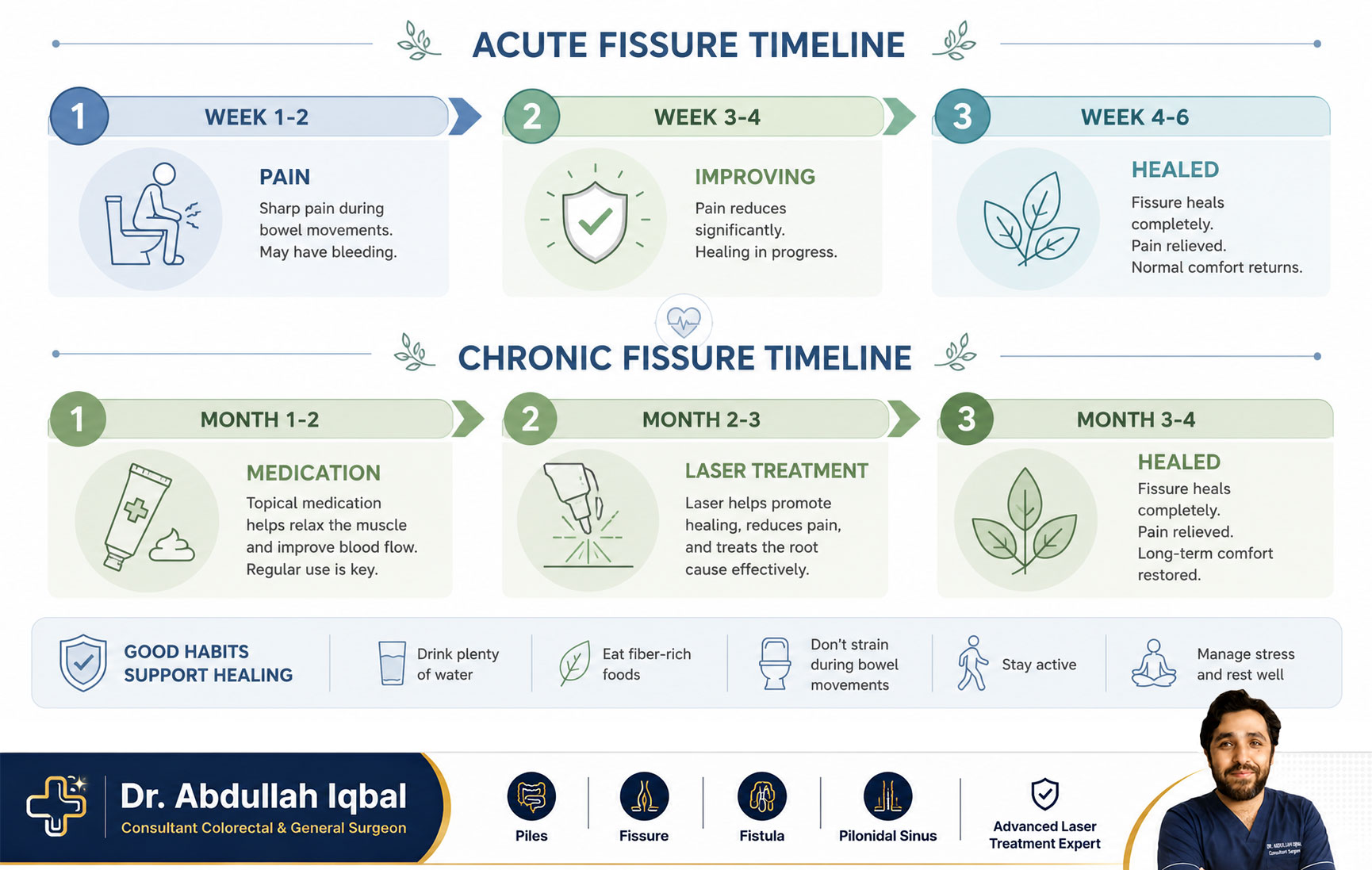
If you have been following all these steps for 6 weeks and the pain has not improved, the fissure is likely chronic. At this point, creams and diet alone will not solve the problem. I strongly suggest consulting a specialist for laser fissure treatment — the procedure takes 10-15 minutes, you go home the same day, and pain relief begins within 48 hours.
In many cases, patients come to me after suffering for 6 months to a year. They tell me — “Doctor, kaash main pehle aa jata.” Do not make the same mistake. Fissure is treatable, and the sooner you get proper treatment, the sooner you return to normal life.
Related Reading
If you are dealing with fissure, these articles may help you understand your condition better:
• Fissure Meaning in Urdu — Piles Se Kya Farq Hai?
• 5 Simple Ways of Anal Fissure Home Treatment
• 4 Major Reasons Why Fissure Surgery Becomes Necessary
• Laser Sphincterotomy for Anal Fissure
• Fissure Healing Timeline — Complete Recovery Guide
• Piles Treatment in Karachi — Laser Hemorrhoidoplasty
Frequently Asked Questions
Fissure ka dard bardasht se bahar hai? Aaj hi appointment lein.
Dr. Abdullah Iqbal — Pakistan’s First Laser Proctologist | Hill Park General Hospital

- Fissure Cream vs Laser Treatment — Which One Actually Works? - June 29, 2026
- Fissure During Pregnancy — Safe Treatment Options and What to Avoid - June 22, 2026
- Going to the Washroom with Fissure — 7 Tips That Actually Reduce Pain - June 15, 2026
