
MBBS · FCPS · Internationally Trained · ESCP · FASCRS • PMDC Verified #63108-S • 13,000+ Patients Treated • Same-Day Discharge • Hill Park General Hospital
Laser Fissure Treatment in Karachi — Laser Sphincterotomy by Dr. Abdullah Iqbal
Last updated: June 27, 2026 · Reviewed by Dr. Abdullah Iqbal, MBBS, FCPS
Book a Direct Consultation with Dr. Abdullah Iqbal
Speak directly with Dr. Abdullah Iqbal. No third-party booking platforms.
Your information is confidential and used only to schedule your consultation. See our Privacy Policy.
Prefer to talk now? 0333-2877351 • WhatsApp
How is anal fissure treated with laser — and is it painful?
Anal fissure is treated with laser sphincterotomy — a 10–15 minute day-care procedure that relaxes the sphincter muscle spasm and allows the tear to heal permanently. Dr. Abdullah Iqbal, Pakistan’s first laser proctologist, performs this at Karachi Piles Clinic, Hill Park General Hospital. Pain relief begins within 48 hours, and most patients return to normal activities in 5–7 days.
| Condition | Anal Fissure (Fissure-in-ano — شق) |
| Specialist | Dr. Abdullah Iqbal — MBBS, FCPS, Specialised Laser Proctology Training (International), Karachi |
| Techniques Available | Laser Sphincterotomy, GTN Cream, Diltiazem Cream, Botox Injection, Open LIS |
| Laser Surgery Cost | PKR 130,000–150,000 |
| Conservative Treatment Cost | PKR 2,000–10,000 |
| Anesthesia | Local or spinal — no general anesthesia required |
| Hospital Stay | Day-care — no admission needed |
| Recovery (Laser) | 3–5 days to routine activity | Full healing 3–4 weeks |
| Recovery (Open LIS) | 3–4 weeks with wound care |
| Location | Karachi Piles Clinic |
| PMDC Verified | #63108-S |
| Last Reviewed | May 2026 by Dr. Abdullah Iqbal |
I am Dr. Abdullah Iqbal — Pakistan’s first laser proctologist. I completed my MBBS in 2012, my FCPS in General Surgery in 2018, and I completed specialised laser proctology training at an international level in 2021. For the past several years I have dedicated my practice exclusively to laser treatment of proctological conditions at Karachi Piles Clinic. I want to say something honest before we go any further: anal fissure is the condition I see being suffered in silence more than almost anything else. Every week, patients come to me who have been in real pain for months — sometimes years — simply because they were too embarrassed to seek help. I do not want that for you. If every visit to the bathroom feels like passing broken glass, you are in exactly the right place. Let me explain everything clearly, the way I would if you were sitting in front of me right now.
📲 WhatsApp Dr. Abdullah directly: +92-333-2877351
What is an Anal Fissure? (Fissure ka matlab kya hai?)
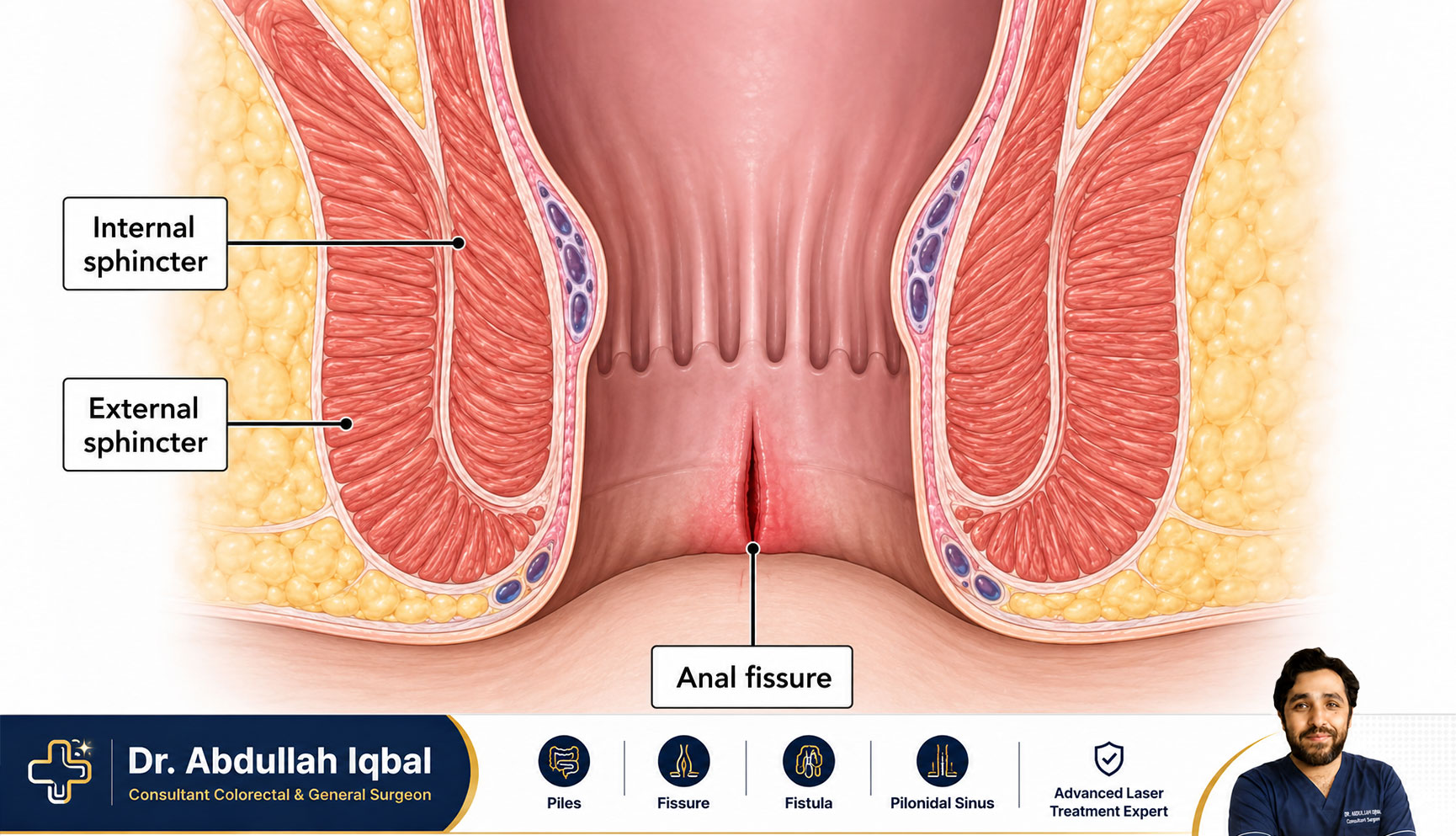
In the simplest terms I can offer — a fissure is a small tear in the inner lining of the anal canal. It is usually less than a centimeter long. I always tell my patients: it is a tiny wound in an extremely sensitive location, and this is why the pain it causes is completely out of proportion to its size. People cannot believe something so small could hurt so much. I believe them entirely — I have seen this condition disable working adults, disrupt sleep, and cause patients to dread something as normal as a morning bathroom visit. Here is what I hear most often when patients describe it to me:
- A burning, knife-like pain during and for hours after passing stool
- Bright red blood on the tissue paper (NOT mixed in the stool — that’s a different problem)
- A constant, low-grade aching between bowel movements
- Fear of going to the toilet — which makes constipation worse and creates a vicious cycle
In Urdu we call this fissure ka dard or paakhana karte waqt jalan aur khoon ana. Most patients I see in Karachi have been suffering silently for months — sometimes years — because of embarrassment. Let me be clear: this is a common, treatable medical problem. There is no shame here.
Piles vs Fissure vs Fistula — Don’t Confuse Them
I always make time to clarify this distinction in my consultations, because I have seen patients who spent months treating the wrong condition. The three overlap in location but differ completely in cause, sensation, and treatment — and in my opinion, getting this diagnosis right from the start saves enormous time and suffering:
Piles (Bawaseer / Hemorrhoids) — swollen blood vessels inside or just outside the anal canal. The dominant complaint is painless bleeding: bright red blood dripping into the toilet or visible on tissue, sometimes accompanied by a feeling of “something coming down” during a bowel movement. Piles hurt when they prolapse or thrombose, but they do not usually produce the knife-like sting of a fissure. If your main symptom is bleeding without sharp pain, you may be looking at piles — see our complete guide to laser piles treatment in Karachi.
Fissure (this page) — a tear in the anal lining. The dominant complaint is severe sharp pain during and after a bowel movement, with small amounts of bright red blood on the paper. Pain is the headline symptom; bleeding is minor.
Fistula (Bhagandar) — an abnormal tunnel between the anal canal and the skin around it, usually starting from a previous abscess. The dominant complaints are persistent discharge, pus, recurrent swelling, and occasionally fever. Pain is constant rather than only at the time of a bowel movement. A chronic untreated fissure can occasionally progress into a fistula — this is one reason not to delay treatment. Learn more about laser fistula treatment.
If you are unsure which condition you have, send me a brief WhatsApp message at 0333-2877351 describing your symptoms and I will guide you to the right next step.
Acute vs Chronic Fissure — A Critical Distinction
This separation matters because it changes the treatment entirely:
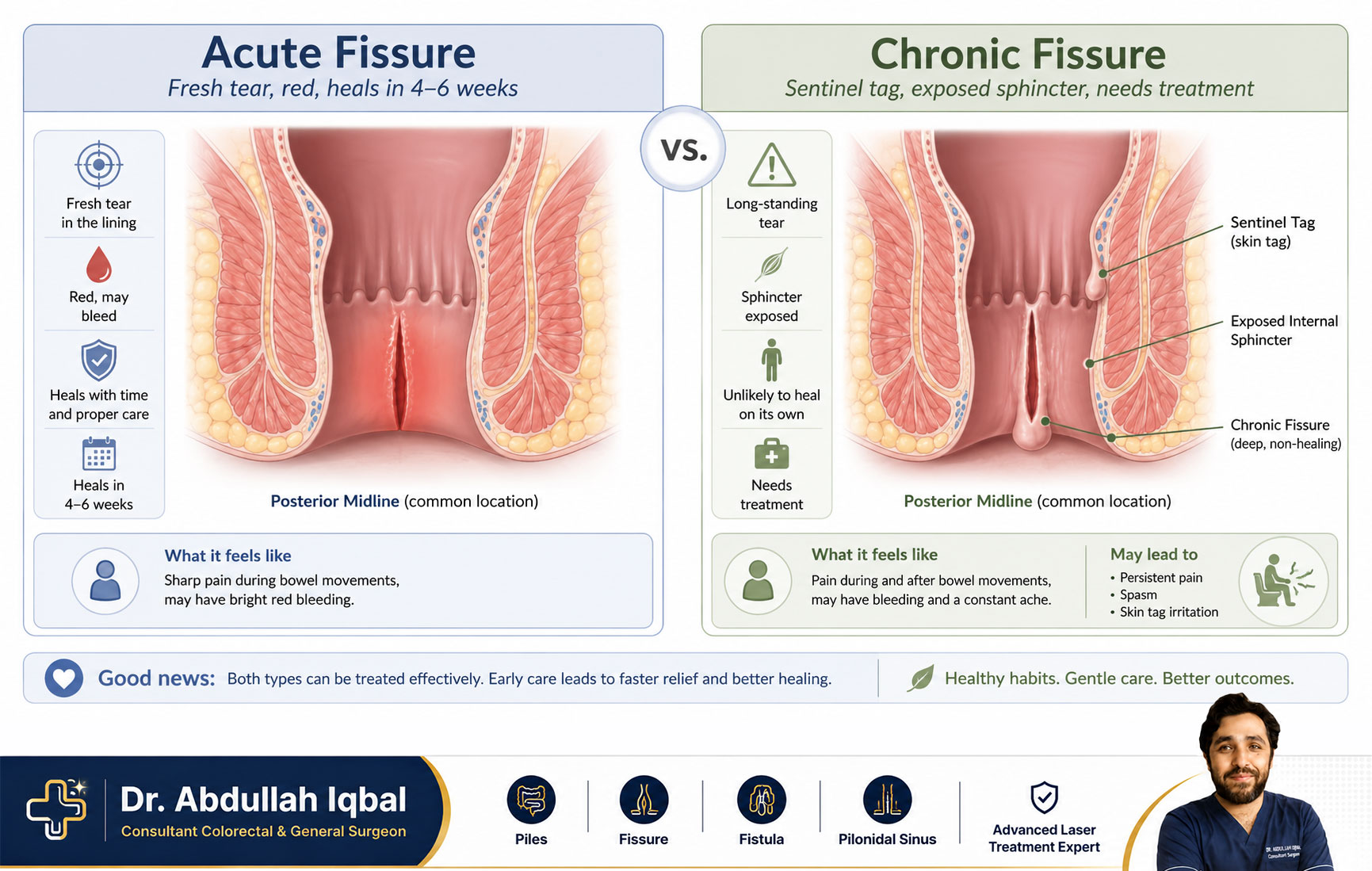
- Acute fissure (less than 6 weeks): A fresh tear. Often heals on its own with conservative treatment.
- Chronic fissure (more than 6–8 weeks): The tear has refused to heal because the internal anal sphincter is in spasm — squeezing the area shut and starving it of blood supply. A chronic fissure rarely heals without breaking that spasm.
If you’ve had fissure pain for more than 8 weeks, conservative treatment alone will probably not work. That’s where laser sphincterotomy comes in.
What Happens If You Ignore a Chronic Fissure?
I do not like to see patients who have been suffering for years when I know a single procedure could have fixed this much earlier. Embarrassment is the most common reason people delay — I have heard it hundreds of times. But I believe it is my responsibility to be honest about what delay actually costs:
- Pain becomes chronic and disabling. A spasm-locked fissure rarely heals on its own after the 8-week mark. Daily life narrows around bowel movements — patients avoid travel, avoid spicy food, avoid social outings.
- Constipation worsens. Fear of pain leads to deferred bowel movements, which leads to harder stool, which tears the fissure further. The cycle reinforces itself.
- Sentinel skin tags develop. A small fleshy tag at the lower edge of the fissure — visible to the patient — is the body’s response to chronic inflammation. Once formed, it does not resolve on its own and usually needs surgical removal alongside the sphincterotomy.
- Risk of progression to fistula. A chronic fissure occasionally develops a deeper infection that creates an abscess and then a fistula tract. At that point treatment becomes more complex — see our laser fistula treatment page for what that involves.
- Quality of life drops silently. Patients adapt to chronic discomfort and stop noticing how much it limits them. The first thing most of my post-surgery patients say at the 3-week follow-up is: “I forgot what feeling normal was like.”
I strongly advise: the earlier you come, the simpler the treatment. Do not let embarrassment cost you years of pain that was completely avoidable.
Why Anal Fissure Happens
The most common causes I see at Karachi Piles Clinic:
- Chronic constipation — hard stools tear the anal lining
- Diarrhea — repeated wiping and acidic stool inflame the area
- Childbirth — postpartum fissures are surprisingly common
- A diet low in fiber and water — the Karachi reality for most working people
- Sitting for long hours — common in office workers and drivers
- Spicy food — yes, masaledar khana does aggravate existing fissures
Red Flags — When to See a Doctor Without Delay
Most anal fissures are not dangerous in themselves. But certain symptoms require prompt medical evaluation — not because they suggest a fissure has worsened, but because they may point to a different problem that needs ruling out. Please see me, or any qualified colorectal surgeon, without delay if you notice:
- Blood mixed inside the stool rather than just on the paper or in the bowl (this can indicate a bleeding source higher up in the bowel)
- Black or tar-coloured stool — suggests upper gastrointestinal bleeding
- Persistent bleeding despite 2–3 weeks of conservative measures
- Unexplained weight loss alongside any anal symptoms
- A change in bowel habit lasting more than 4 weeks — new-onset constipation, or constipation alternating with diarrhoea
- Family history of colorectal cancer alongside new anal bleeding, at any age
- Anal pain accompanied by fever, swelling, or pus discharge — suggests infection rather than a simple fissure
Most of the time these turn out to be benign, but they deserve a proper examination and where indicated, further investigation such as a colonoscopy. WhatsApp me at 0333-2877351 with a brief description of your symptoms — I will tell you straight away whether you can manage at home or whether you should come in.
Conservative Treatment — What I Try First
I do not believe in recommending surgery as a first step. I always trial conservative treatment for 4 to 6 weeks before discussing any procedure. In my experience, a significant number of acute fissures heal completely with nothing more than the following measures, done consistently and correctly:
1. Sitz Baths (Tub Bath / Garam Pani ki Tikor)
I advise all my fissure patients to sit in a clean basin of warm water for 10 to 15 minutes, 2 to 3 times a day. I find this gives faster pain relief than any cream. It relaxes the anal sphincter, improves blood flow to the tear, and reduces spasm almost immediately. Cost: essentially zero. I always say — if you only do one thing from this list, do the sitz baths. Every single time, without fail.
2. GTN Cream (Glyceryl Trinitrate 0.2–0.4%)
Available in Pakistan as Rectogesic or as a compounded preparation. I prescribe this to relax the internal anal sphincter chemically — breaking the spasm cycle that prevents healing. Apply a small amount around the anal opening twice daily for 6 to 8 weeks. I always warn patients about one side effect: headache. About 1 in 4 patients gets this, especially in the first week. I believe it is worth tolerating for the benefit. If the headache is genuinely too severe, I switch to Diltiazem cream as an alternative.
3. Xyloaid Cream (Lidocaine + Hydrocortisone)
This is my immediate-pain-relief option. Lidocaine numbs; hydrocortisone reduces inflammation. I advise applying it 15 minutes before passing stool. I always tell patients — do not use this for more than 3 to 4 weeks continuously. Long-term steroid use thins the skin, which is the opposite of what we want.
4. Fiber Supplements + 3+ Litres of Water Daily
Soft, bulky stool is the absolute foundation of healing. I prescribe Ispaghol (psyllium husk) — 2 teaspoons twice a day with a full glass of water. I always say this bluntly in my clinic: if you are not drinking 3 litres of water a day, nothing else will work properly. Hydration is non-negotiable. If a patient keeps passing hard stool, no cream in the world will heal their fissure — I am completely convinced of this.
5. Avoid Straining
I always tell my patients — sit on the toilet for 5 minutes maximum. If it does not happen, get up and come back. I do not agree with reading, scrolling the phone, or spending 15 to 20 minutes in there. Straining increases the pressure that tears the fissure with every single visit. This habit alone can undo weeks of other treatment.
If after 6 weeks of disciplined conservative treatment the fissure is not healing — or if the pain is severe enough to affect work or sleep — that is when I recommend we discuss surgery. I never suggest surgery lightly, but I also do not think it is kind to keep a patient suffering unnecessarily when a solution exists.
Laser Sphincterotomy — The Modern Solution
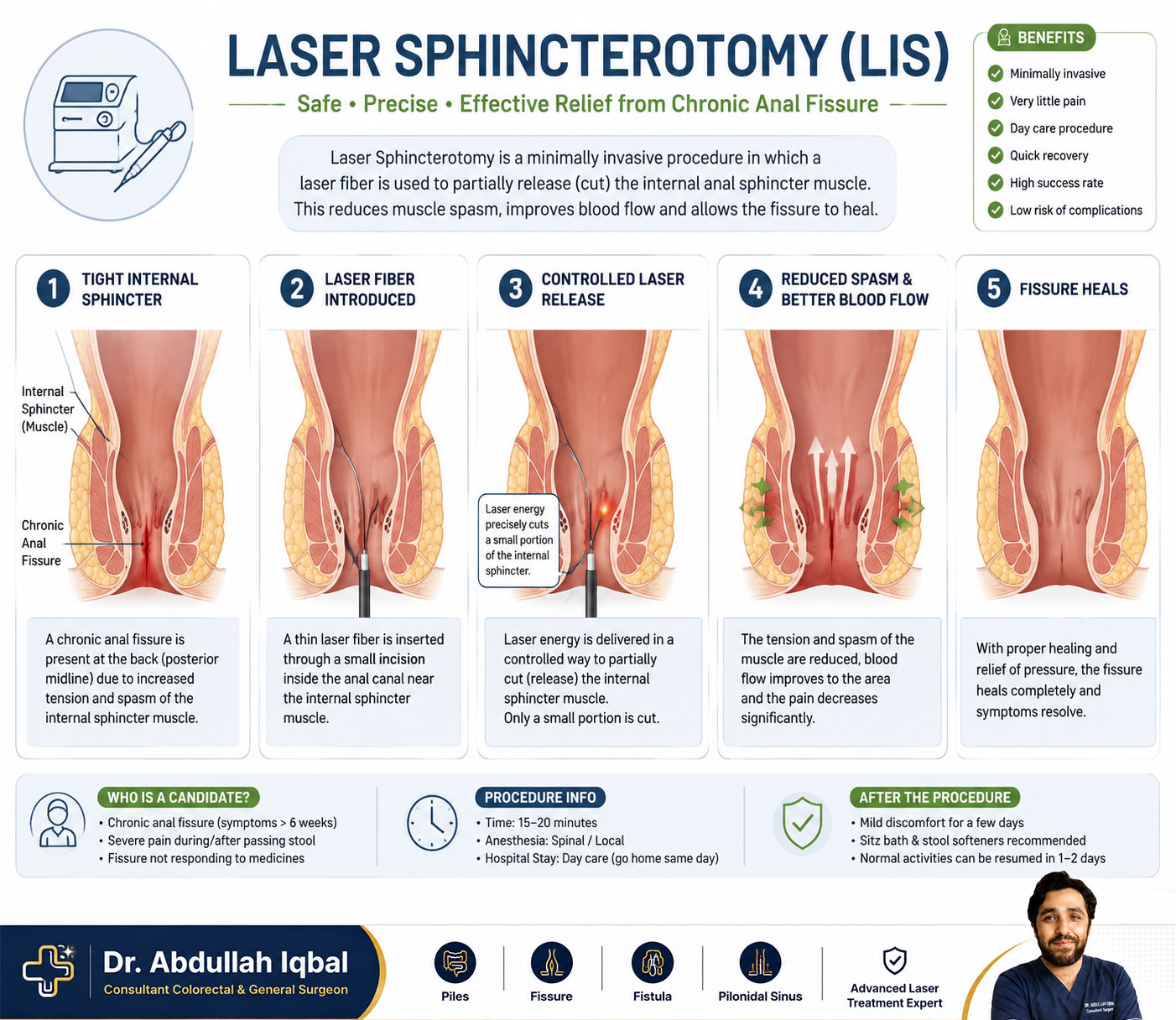
Laser lateral internal sphincterotomy is the procedure I perform for chronic anal fissures. The concept is straightforward: I use a precise laser fiber to release a measured portion of the internal anal sphincter — just enough to break the spasm that is preventing healing, without touching the muscles responsible for continence. I have performed this procedure many times and I am confident saying: when done correctly, the relief for the patient is often dramatic within 48 hours.
How the Laser Procedure Works
- You’re admitted as a day-care patient — no overnight stay
- Spinal or short general anesthesia (your preference + medical fitness)
- I introduce a fine laser fiber and release a measured portion of the internal sphincter
- The fissure itself often heals on its own once the spasm is gone, but for chronic cases I also clean the fissure edges with the laser
- Total procedure time: 15–25 minutes
- You’re discharged within 4–6 hours — most patients walk out
Why Laser is Better Than Conventional Sphincterotomy
I want to be honest here — conventional open sphincterotomy is a good operation. It has been the gold standard for decades and it works. I do not dismiss it. However, in my experience and in my opinion, laser delivery of the same procedure offers real advantages that matter to patients in their daily lives. Here is how conventional surgery compares:
- The incision wound takes 3–4 weeks to heal
- Pain in the first week is significant
- Small but real risk of bleeding from the incision
- The cut is harder to calibrate precisely
Laser sphincterotomy in my hands offers these advantages:
- Bloodless — the laser seals tiny vessels as it works. I have not had significant intraoperative bleeding in my laser cases.
- More precise — I can calibrate the depth of sphincter release to the millimetre. With a scalpel this is harder to control consistently.
- No external wound to heal — conventional surgery requires an incision and dressings for weeks. There is no equivalent wound with laser.
- Pain relief within 48 hours — the sharp fissure pain the patient came in with typically resolves as the spasm releases. Many patients say this is the first time they slept well in months. I find this deeply satisfying every time.
- Back to office work in 3–5 days for most patients
Fissure Surgery Cost in Karachi — Real Numbers, No Hidden Charges
Let me give you actual numbers — no vague “depends on case” answers:
| Treatment | Cost (PKR) |
|---|---|
| Initial consultation | Rs. 2,000 |
| GTN cream (6-week course) | Rs. 800 to Rs. 1,500 |
| Xyloaid cream | Rs. 400 to Rs. 800 |
| Conventional open sphincterotomy (Karachi market) | PKR 70,000 to 85,000 |
| Laser sphincterotomy at Karachi Piles Clinic | PKR 130,000 to 150,000 |
Yes, laser costs more. I always have this conversation directly with my patients. Here is the calculation I advise them to make honestly:
- Conventional surgery: 1 week off work + dressings for 3 weeks + risk of non-healing wound requiring revision
- Laser surgery: 3–5 days off work + no external wound + high single-procedure success rate
For most working professionals, the difference in lost income and follow-up costs makes laser comparable or cheaper in total. The laser fee includes the surgeon’s fee, anesthesia, OT time, day-care charges, and your follow-up visits. Hospital admission charges (if needed for medical reasons) are billed separately by Hill Park General Hospital.
Laser fissure surgery is covered under most insurance policies.
Laser sphincterotomy is treated as a surgical procedure under EFU, Jubilee, Adamjee, IGI and most Pakistani health insurance panels — meaning you may pay little or nothing out of pocket. Read the accepted insurance panels and the simple pre-authorization process before your consultation.
What I Recommend Based on Your Situation
I advise conservative treatment first — sitz baths, GTN cream, fiber, and hydration — if your fissure is:
- Less than 6 weeks old
- Not bleeding heavily
- You can tolerate the pain enough to comply with the regimen
I recommend moving to laser surgery if:
- Conservative trial has failed for 6–8 weeks
- The fissure is chronic with a visible “sentinel” skin tag
- Pain is severe enough to affect your work or sleep
- You’ve already tried and failed GTN cream
The Day of Surgery — What to Expect
- Arrive 1–2 hours before scheduled time at Karachi Piles Clinic, Hill Park General Hospital
- Bring your blood reports and any medications you’re taking
- 6-hour fasting before procedure (water OK up to 2 hours before)
- A family member should accompany you for discharge
- Light lunch after discharge — soft foods for the first 24 hours
- First sitz bath the same evening
- WhatsApp follow-up next morning
Recovery After Laser Fissure Surgery
- Day 0–1: Mild discomfort, manageable with paracetamol. First normal bowel movement is usually comfortable, without sharp pain.
- Day 2–3: Most patients return to desk work
- Day 7: Clinic follow-up. Sitz baths continue.
- Day 21: Final follow-up. Most fissures fully healed.
- Long-term: Low recurrence rate if dietary habits are maintained
Why Choose Karachi Piles Clinic for Fissure Treatment
I will answer this honestly rather than with marketing claims. I am Dr. Abdullah Iqbal — MBBS (2012), FCPS General Surgery (2018), specialised laser proctology training at an international level (2021). I am Pakistan’s first laser proctologist. I have performed over 5,000 laser procedures for piles, fissure, fistula, and pilonidal sinus at Karachi Piles Clinic.
What I believe genuinely makes a difference: I take fissure seriously as a condition — not a minor complaint. I always try conservative treatment first. I do not recommend surgery unless it is truly indicated. I am accessible on WhatsApp for any question before, during, or after treatment. My clinic at Hill Park General Hospital is easily accessible from DHA, Clifton, PECHS, Bahadurabad, Gulshan, and North Nazimabad. I see patients on Tuesday, Thursday, and Saturday — 5:00 PM to 8:00 PM.
Helpful Guides for Fissure Patients
• How Long Does a Fissure Take to Heal? — Recovery Timeline
• Washroom Tips to Reduce Fissure Pain
• Fissure During Pregnancy — Safe Treatment Options
• Fissure Cream vs Laser — Which Actually Works?
Frequently Asked Questions
Fissure ka laser ilaj kitna painful hota hai?
Procedure ke dauran aap ko bilkul dard nahi hota — spinal ya general anesthesia di jati hai. Operation ke baad pehle 24–48 ghante mein halki si takleef hoti hai jo paracetamol se aaram se manage ho jati hai. Zyada tar mareez kehte hain ke unka pre-surgery dard jo months se tha — wo 48 ghante mein khatam ho gaya.
How long is recovery after laser fissure surgery in Karachi?
Most patients are back to desk work in 3–5 days. Heavy physical work should wait 10–14 days. Sitz baths continue for 3 weeks. Complete tissue healing takes 3–4 weeks. The fissure pain itself usually subsides within 48 hours of the procedure.
What is the difference between piles and fissure?
Both cause pain and bleeding around the anus, but they’re different conditions. Piles (hemorrhoids) are swollen blood vessels that protrude — they bleed more, hurt less, and feel like a lump. Fissure is a tear in the skin — it bleeds less but hurts severely with every bowel movement. Many patients have both at the same time. I assess and treat them together where needed.
Can chronic anal fissure heal without surgery?
Acute fissures (less than 6 weeks) often heal with sitz baths, GTN cream, fiber and hydration. Chronic fissures rarely do — the underlying sphincter spasm prevents healing. If you’ve had fissure symptoms for more than 2 months and 6 weeks of disciplined conservative treatment hasn’t worked, surgery is the realistic path forward.
Will laser fissure surgery affect my continence?
A properly performed lateral internal sphincterotomy releases only a calibrated portion of the internal sphincter — it does not affect the external sphincter or the muscle responsible for continence. With laser precision the calibration is even more accurate than conventional surgery. The risk of any continence change is very low in experienced hands.
Fissure ka laser ilaj Karachi mein kahan hota hai?
Karachi Piles Clinic mein Dr. Abdullah Iqbal — Pakistan ke pehle laser proctologist — laser fissure treatment perform karte hain. Clinic Hill Park General Hospital, Shahid-e-Millat Road par hai. DHA, Clifton, PECHS, Gulshan aur Bahadurabad se aana asaan hai. Appointment WhatsApp par: 0333-2877351.
Who is the best fissure doctor in Karachi?
Dr. Abdullah Iqbal is Pakistan’s first laser proctologist and a consultant general surgeon (MBBS, FCPS) with 13+ years of surgical experience. He has specialized exclusively in laser treatment of piles, fissure, fistula and pilonidal sinus for over 5 years and has personally performed 5,000+ laser procedures. His clinic, Karachi Piles Clinic at Hill Park General Hospital, treats both English and Urdu-speaking patients.
Can a fissure come back after laser sphincterotomy?
The fissure itself rarely recurs once the underlying sphincter spasm has been released — that is the whole point of the procedure. The most important predictor of long-term freedom from fissures is what happens after surgery: stay on a high-fibre diet, drink 3+ litres of water daily, avoid prolonged toilet sitting, and treat any constipation promptly. Most patients who maintain these habits do not see the problem return.
Is the bright red blood from a fissure dangerous?
The volume of blood from a typical fissure is small — drops or streaks on the toilet paper, sometimes a small smear in the bowl. This is rarely dangerous in itself. What matters is where the blood is. Bright red blood on the surface of the stool or on paper after wiping points toward a low source (fissure or piles). Dark blood, blood mixed into the stool, or any black tar-like material requires evaluation for an upper bleeding source. When in doubt, share a photo on WhatsApp — I can usually tell from the appearance what we are dealing with.
Will I need a colonoscopy for a fissure?
Most patients with a clear-cut fissure do not need a colonoscopy. The diagnosis is usually made by history and a gentle external examination — no internal scope is necessary. A colonoscopy is recommended only when there are red-flag symptoms, when the bleeding pattern does not match a simple fissure, or in patients over 45 who have not had any screening. Where a colonoscopy is indicated, I refer to trusted colleagues at Hill Park General Hospital.
Book Your Consultation
If you have been suffering with fissure pain — for weeks or for years — I want you to come and see me. A proper assessment takes one appointment. WhatsApp my assistant directly and we will arrange a time:
📲 +92-333-2877351 or +92-321-2363611
Karachi Piles Clinic | Hill Park General Hospital, Shahid-e-Millat Road, Karachi
For full clinic location, OPD schedule, and a direct contact form, visit our contact page.
Tuesday, Thursday, Saturday | 5:00 PM – 8:00 PM
Related reading on this site
- Difference Between Piles, Fissure and Fistula — Complete Comparison
- Fissure Meaning in Urdu — Aur Iska Bawaseer Se Kya Farq Hai?
- 4 Major Reasons Of Anal Fissure Surgery
- Anal Fissure Laser Treatment — A Fast, Day-Care Solution
- Bawaseer Aur Fissure Mein Kaun Sa Khana Nuksan Karta Hai
- Effective Home Remedies for Piles, Fissures, and Fistulas
- 5 Simple Ways Of Anal Fissure Home Treatment
Trusted Medical References
For patients who want to read more from established international sources, these references align closely with the approach I take in clinic. Treatment guidelines vary slightly between countries and surgical schools, but the principles are universal: conservative measures first, surgery only when conservative measures fail, and lateral internal sphincterotomy as the procedure with the strongest long-term evidence. Laser delivery of that procedure is what we offer at Karachi Piles Clinic.
- Mayo Clinic — Anal Fissure (symptoms & causes)
- NHS UK — Anal Fissure
- Cleveland Clinic — Anal Fissures
- NCBI StatPearls — Anal Fissure (peer-reviewed clinical review)
Last Updated: 27 May 2026 · Reviewed by Dr. Abdullah Iqbal (MBBS, FCPS · ESCP · FASCRS — PMDC Verified #63108-S)
Medical Disclaimer:
The information on this page is for educational purposes only and does not constitute medical advice. Consult Dr. Abdullah Iqbal directly for diagnosis and treatment.