
Of all the pilonidal sinus recurrence cases I see at Karachi Piles Clinic, a good portion of them have already had surgery before. Somewhere else. And it came back. Sometimes within months. And they are frustrated, and I completely understand why.
This article is about why pilonidal sinus recurs and what can actually be done to fix it for the long term. I will be direct.
Why Does It Come Back?
This is where most patients have been misled. They think their pilonidal sinus “grew back.” In reality, the original surgery failed to eliminate the root cause — or worse, the technique used actually increases recurrence risk.
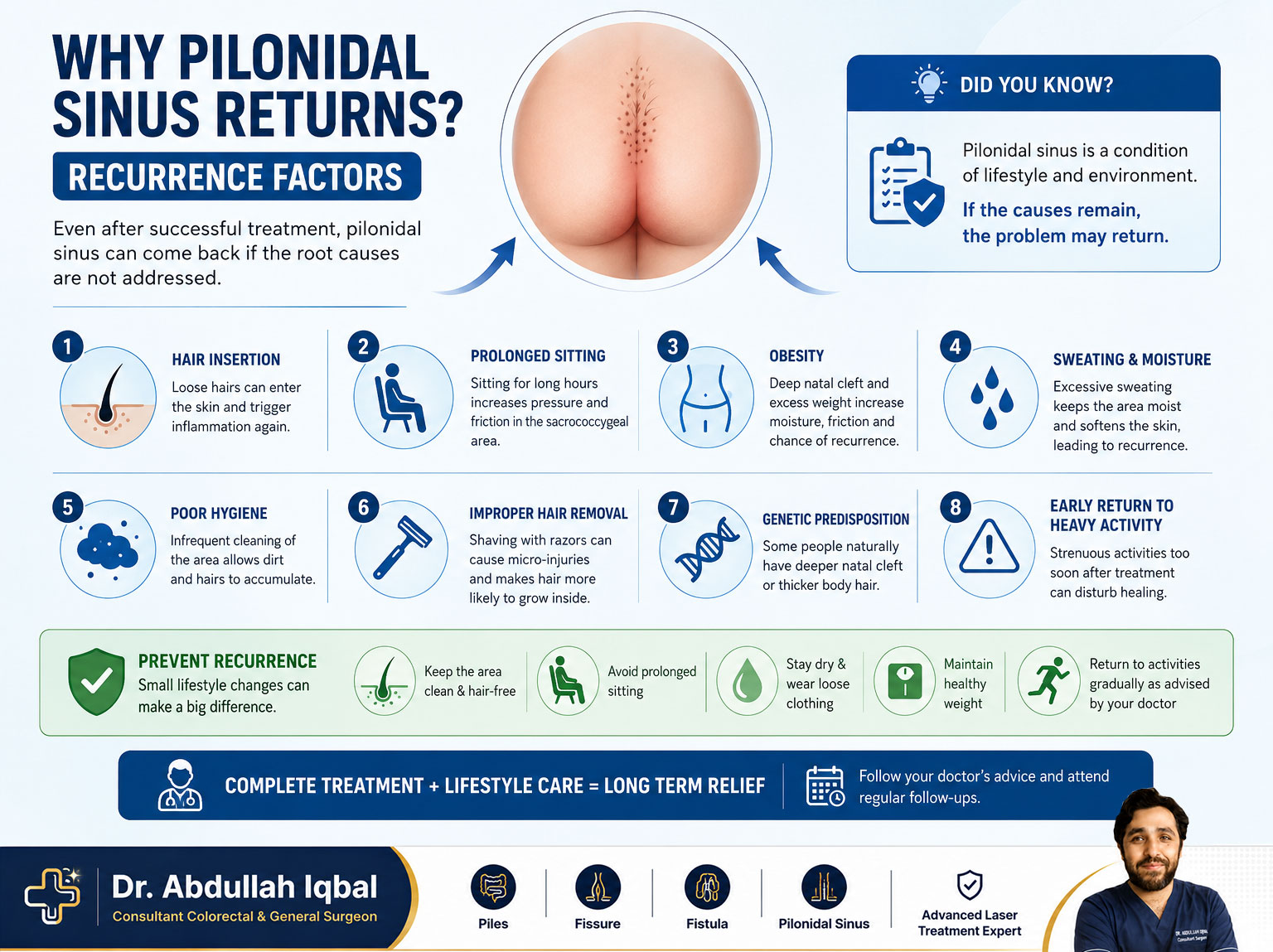
The main reasons pilonidal sinus recurs:
- Midline closure technique. When the wound is closed directly in the midline (on the crack between the buttocks), the scar sits in the highest-pressure area. Hair gets embedded again. Infection follows. This is the single biggest cause of recurrence.
- Incomplete removal. If the sinus tracts were not fully mapped and removed, remnant tracts continue to cause disease.
- No attention to natal cleft depth. A deep natal cleft traps sweat, debris, and hair. If the surgery does not address this, the environment that caused the pilonidal sinus still exists.
- Patient factors. Coarse body hair, obesity, prolonged sitting, poor hygiene — these are contributing factors that also need to be managed.
Recurrence Rates by Technique
Not all pilonidal sinus surgeries carry the same recurrence risk. In my opinion, this data is something every patient should know before choosing their procedure.
| Procedure | Technique Type | Recurrence Rate |
|---|---|---|
| Open excision midline closure | Midline | 20 – 30% |
| Laser Sinus Closure | Minimally invasive | 8 – 12% |
| Bascom Cleft Lift | Off-midline | 5 – 8% |
| Karydakis Flap | Off-midline | 3 – 7% |
| Limberg Flap | Off-midline flap | 1 – 5% |
I have noticed this pattern consistently in my practice. The patients who had open midline closure elsewhere come back with recurrence. The ones who had off-midline procedures don’t, mostly.
What is the Best Option for Recurrent Cases?
For a primary (first-time) case in a young patient with small sinus — Laser Sinus Closure is excellent. Quick, minimal downtime, good results.
For recurrent cases — especially if there was a previous midline excision — I recommend flap procedures. The Limberg flap is my personal preference for complex recurrent cases because of its consistently low recurrence rates. The Karydakis is also excellent and has decades of evidence behind it.
In my opinion, recurrent pilonidal sinus is not a reason to give up hope. It is a reason to choose the right technique this time.
Kya aapka pilonidal sinus pehle bhi hua tha aur dobara aa gaya? Yeh bahut common hai — aur yeh fix ho sakta hai properly.
What About Lifestyle Changes to Prevent Recurrence?
Surgery fixes the structural problem. But lifestyle changes reduce the risk further:
- Shave or laser the hair in the sacrococcygeal area regularly
- Lose weight if overweight — this genuinely reduces natal cleft depth
- Take breaks from prolonged sitting every 30 to 45 minutes
- Keep the area clean and dry, especially after sweating
These changes do not guarantee zero recurrence but they significantly tip the odds in your favour.
What I Do Differently
At Karachi Piles Clinic, before recommending a procedure for recurrent pilonidal sinus, I do a thorough examination and in some cases request imaging. We map the sinus tracts. We assess the natal cleft anatomy. Only then do we plan surgery.
This is not standard everywhere. But in my experience, this approach gives the best long-term results.
Read about all the pilonidal sinus treatment options including Limberg flap in detail. Also understand the cost implications for recurrent cases.
Also, if you had an abscess recently and are planning definitive surgery, read my guide on surgery vs laser therapy comparison. For fistula patients who also deal with recurrence, see fistula treatment.
After your procedure, follow the recovery aftercare guide for best healing results.
Frequently Asked Questions
Why does pilonidal sinus come back after surgery?
The most common reason is midline wound closure which places the scar in the highest-pressure area. Other causes include incomplete removal and unchanged natal cleft anatomy. Off-midline techniques have much lower recurrence rates.
Which surgery has the lowest pilonidal sinus recurrence rate?
Limberg flap has the lowest recurrence rate of 1 to 5%. Karydakis flap is also 3 to 7%. Both are off-midline techniques performed by Dr. Abdullah Iqbal at Karachi Piles Clinic.
Can recurrent pilonidal sinus be treated for the long term?
Yes. With the right assessment and off-midline technique, long-term healing is achievable in most cases. Dr. Abdullah Iqbal assesses each recurrent case individually including imaging before recommending surgery.
How can I prevent pilonidal sinus from coming back?
Regular hair removal, avoiding prolonged sitting, maintaining healthy weight, and keeping the area clean and dry all significantly reduce recurrence risk after surgery.
Recurrent cases are handled at Karachi Piles Clinic — book a consultation and we will assess your specific situation properly.
Related reading
- Pilonidal Sinus Recovery Guide — Complete Aftercare After Laser and Flap Surgery
- Pilonidal Sinus Ka Ilaj: Surgery ya Laser Therapy?
- Pilonidal Sinus Surgery Cost in Karachi 2026 — All Procedures Price Breakdown
- Pilonidal Sinus Surgery Preparation Guide — What to Do Before Your Operation
- Pilonidal Sinus Abscess — Emergency Signs, Immediate Care and Definitive Treatment in Karachi
- laser pilonidal treatment
- Fistula treatment in Karachi
- Contact Karachi Piles Clinic

- Fissure Cream vs Laser Treatment — Which One Actually Works? - June 29, 2026
- Fissure During Pregnancy — Safe Treatment Options and What to Avoid - June 22, 2026
- Going to the Washroom with Fissure — 7 Tips That Actually Reduce Pain - June 15, 2026
