


A lot of patients who come to my clinic — mostly from Karachi — ask me the same thing. “Doctor, appendix in Urdu ko kya kehte hain?” And honestly, there is no proper Urdu word for it. The word used is simply اپنڈکس — borrowed directly from English. But that is actually the smaller question. The bigger one is: what exactly is the appendix, what happens when it gets infected, and when should you actually worry? Let me walk you through all of it — clearly, and from my own experience as a surgeon.
What Is the Appendix and Where Exactly Is It Located in the Body?
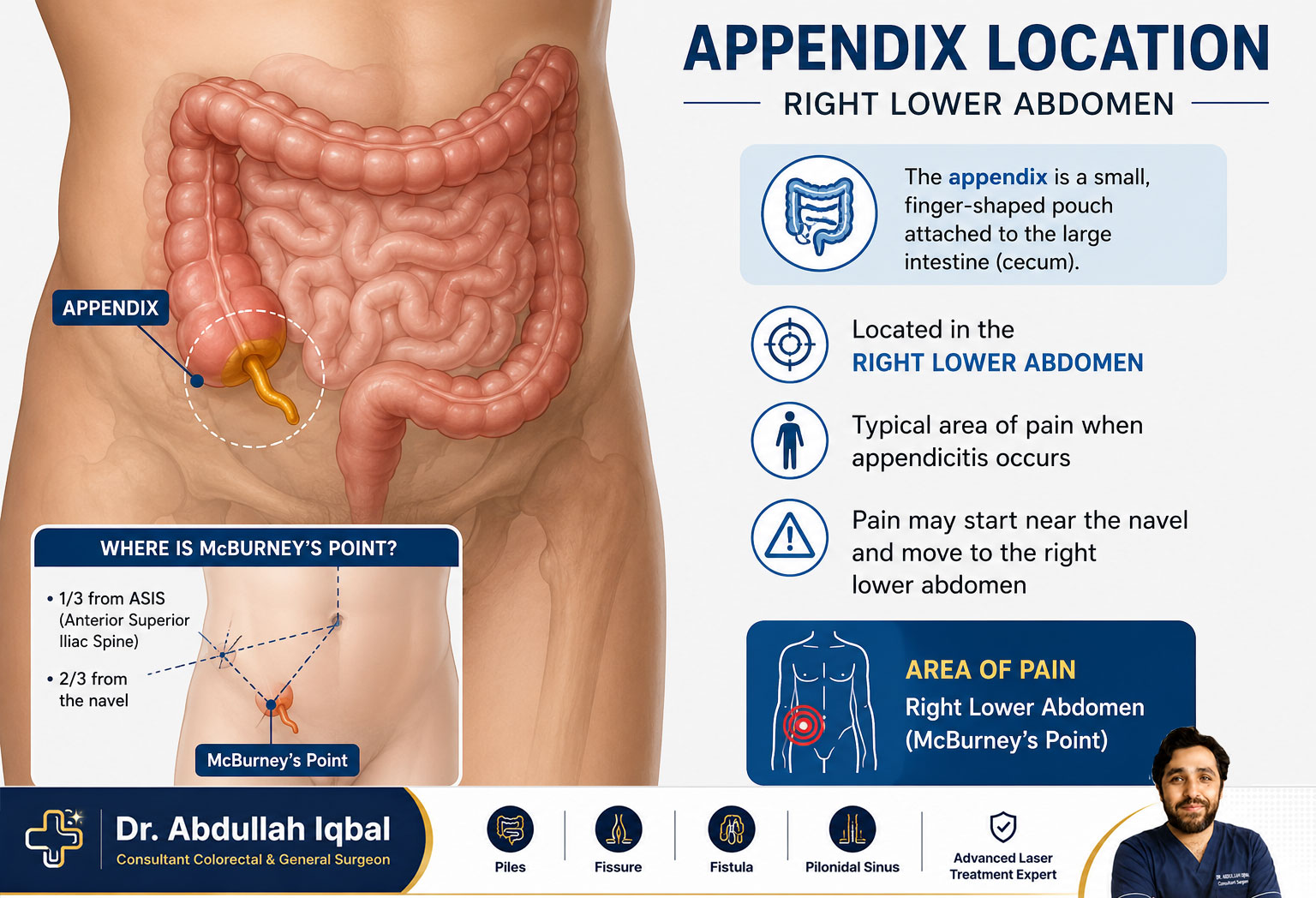
The appendix is a small, finger-shaped pouch attached to the large intestine, sitting in the lower right side of your abdomen — what doctors call the right iliac fossa. It is roughly 5 to 10 cm long and about 1 to 2 cm wide. Very small, honestly. In my opinion, most people don’t even know they have one until something goes wrong with it.
Now, what does it do? That’s a question science is still debating. Some researchers believe it stores beneficial gut bacteria that help re-seed the digestive system after illness. Others think it plays a minor role in immunity early in life. But here’s the practical reality — I have operated on hundreds of patients and removed their appendix, and not a single one of them had any lasting health problem because of it. The body manages perfectly fine without it.
What Are the Symptoms of Appendix Infection That You Should Not Ignore?
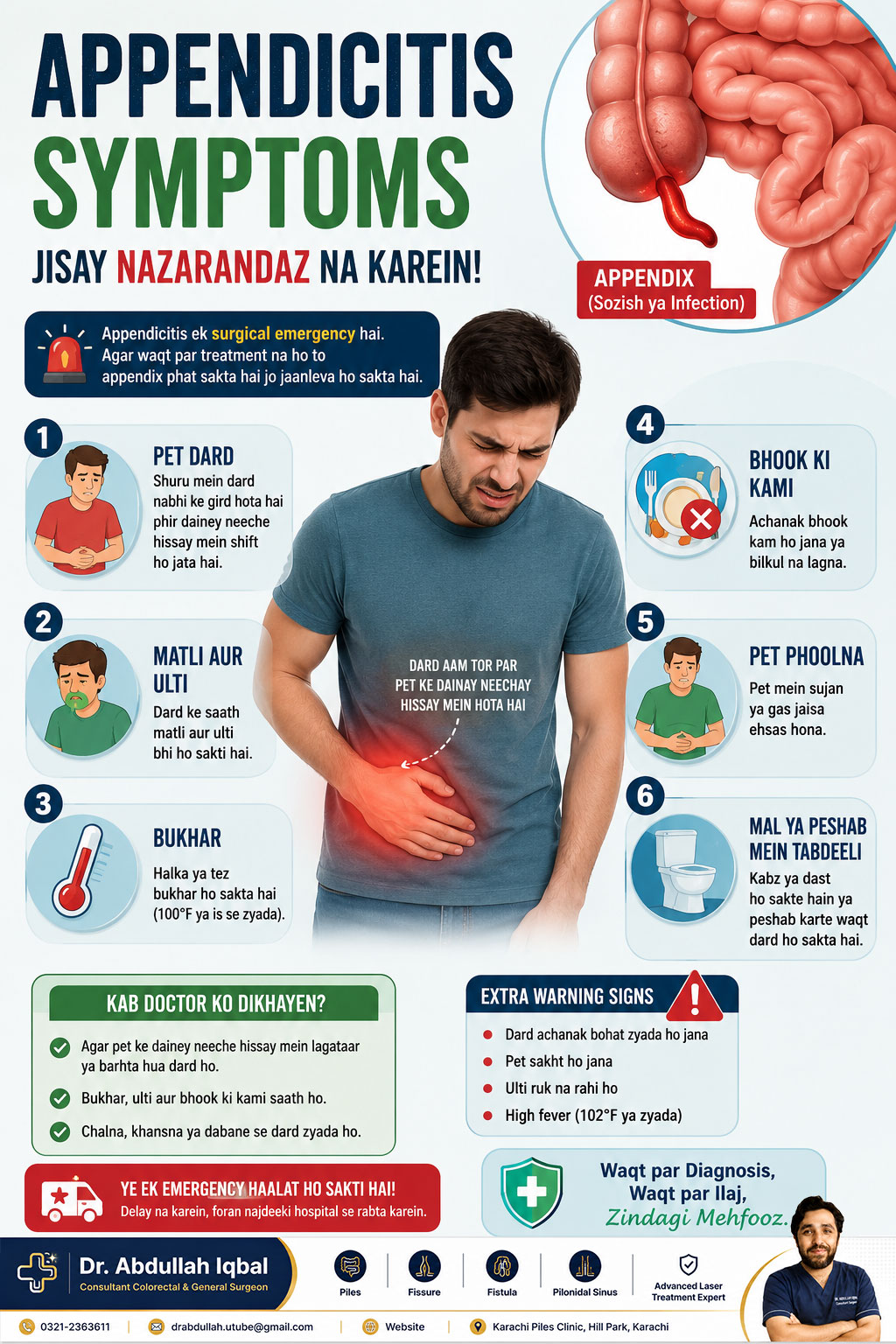
This is where I want you to pay close attention. Appendix symptoms are sneaky — they don’t always announce themselves loudly at first. I have noticed, especially in Karachi, that patients wait 12 to 24 hours at home thinking the pain will pass on its own. Sometimes it does. But when it’s appendicitis, it does not — it keeps building.
Here’s what typically happens. The pain usually starts around the navel — dull, mild, easy to dismiss. Then, over the next few hours, it migrates and settles in the lower right abdomen. That shift is the key warning sign. Along with the pain, most patients also experience:
- Fever — usually low-grade at first, rising over time
- Nausea and vomiting — almost always present
- Complete loss of appetite — even for favourite foods
- Abdominal bloating or tightness
- Pain that worsens when coughing, sneezing, or walking
- A tendency to walk slightly hunched to the right side — patients do this without realising it
- Constipation or difficulty passing gas
Is this what you or someone at home is going through right now? Kya yahi alamaat hain jo aap mehsoos kar rahe hain? If yes — please don’t wait. This is not something to “see how it goes” with.
Where Is the Appendix Pain Located and How Is It Different From Normal Stomach Pain?
This is one of the most common questions I get. Appendix pain location is specific — it starts near the belly button and then moves to McBurney’s point, which is the lower right quadrant of the abdomen. Normal stomach pain from gas or indigestion moves around, comes and goes, and usually settles with a walk or some antacid.
Appendix pain is different. It stays in one place. It gets worse, not better. And in my clinical experience — the patient almost always walks into the clinic slightly bent, holding their right side. That posture alone tells me a lot before I even examine them.
This video explains appendix symptoms and what to expect during diagnosis — by Dr. Abdullah Iqbal.
How Is Appendicitis Diagnosed — What Tests Do Doctors Actually Run?
Diagnosis of appendicitis is based on a combination of clinical examination and investigations. In most cases, a good physical examination is enough to raise strong suspicion. But to confirm, we use:
- Abdominal ultrasound — first-line test, widely available in Karachi, quick and radiation-free
- CT scan of the abdomen — more accurate than ultrasound, especially in obese patients or when the diagnosis is unclear
- Blood tests (CBC and ESR) — elevated white blood cell count confirms active infection
- Urine examination (Urine DR) — to rule out a urinary tract infection, which can mimic appendicitis
In my experience, the CT scan gives us the clearest picture. But honestly, in straightforward cases — right-sided pain, fever, high WBC count — the clinical diagnosis is strong enough that we don’t always need to wait for imaging before making a decision to operate.
What Complications Can Happen If Appendicitis Is Left Untreated?
This is the part most people don’t realise. They think appendix pain will just “go away.” Sometimes the pain does reduce — but that is not a good sign. That can mean the appendix has burst, and now the infection has spread. The pain temporarily eases because the pressure is released — but what follows is far more dangerous.
Untreated appendicitis can lead to:
- Perforation (burst appendix) — the most common complication, happens within 24–72 hours of symptom onset
- Peritonitis — infection spreading to the entire abdominal lining, life-threatening
- Abscess formation — pus collects inside the abdomen, requires drainage
- Septic shock — infection enters the bloodstream, can be fatal
- Bowel adhesions — scar tissue forms after infection, can cause future bowel obstruction
I have personally treated cases where patients waited 3 days thinking it would get better. By the time they reached the operation theatre, the appendix had already burst. Those surgeries are significantly more complex — longer recovery, higher risk. Please, don’t let it get to that point.
What Is the Appendix Operation Cost in Pakistan — And What Does It Include?
Cost is a real concern, and I respect that. People in Pakistan — especially in Karachi — want to know what they’re getting into financially before they commit to surgery. So here is an honest breakdown, as of 2025:
| Factor | Laparoscopic Appendectomy | Open Appendectomy |
|---|---|---|
| Surgery Cost (PKR) | 80,000 – 1,20,000 | 60,000 – 90,000 |
| Hospital Stay | 1–2 days | 3–5 days |
| Recovery Time | 1–2 weeks | 3–4 weeks |
| Scar | Minimal (3 small cuts) | Visible (one larger cut) |
| Best for | Early, uncomplicated cases | Burst appendix or complications |
These cost estimates include surgeon’s fee, anesthesia, hospital room, and basic medications. However, if the appendix has already burst and complications exist, the cost can go higher due to extended ICU stay or additional procedures. My honest advice — come early, and the cost stays manageable.
Where Can You Get Appendix Treatment in Karachi From an Experienced Surgeon?
If you or someone in your family is experiencing appendix symptoms in Karachi — don’t delay. I am available at Karachi Piles Clinic for consultation and surgical management of appendicitis. I have handled both routine and complicated appendectomy cases, laparoscopic and open, and I believe in giving patients clear, honest information before any procedure.
You can book an appointment through drabdullahiqbal.com or reach out directly. For surgical consultation specifically about appendix, visit the appendicitis treatment page here.
Conclusion — What You Need to Know About Appendix in Urdu and in English
So to wrap it up — appendix in Urdu is اپنڈکس, and it’s a small organ in your lower right abdomen that causes major problems when it gets infected. The symptoms are a migrating pain from navel to right side, fever, nausea — and they don’t go away on their own. Diagnosis is done through ultrasound, CT scan, and blood tests. Treatment is surgery — preferably laparoscopic if caught early. And the cost in Karachi, as of 2025, ranges between PKR 60,000 and 1,20,000 depending on the type of surgery.
The most important thing I can tell you — don’t wait. Appendicitis is one of those conditions where time makes everything worse and more expensive. Come early, get checked, and let’s sort it out properly.
Frequently Asked Questions (FAQs)
🔸 What is the very first sign of appendix problems?
The very first sign of appendicitis is typically a dull, crampy pain around the navel (belly button). It’s easy to dismiss at this stage because it doesn’t feel severe. But within hours, this pain shifts to the lower right abdomen and becomes sharper and more persistent. That migration of pain is the classic hallmark of appendicitis. If you notice pain moving from the centre of the stomach to the right lower side — that’s your signal to see a doctor immediately, not tomorrow.
🔸 Can appendicitis go away on its own without surgery?
In very rare cases of mild appendicitis, antibiotics may temporarily reduce inflammation. However, this is not a cure — it’s a delay. In my clinical experience, patients who avoid surgery often return within weeks or months with a worse episode. The definitive and only reliable treatment for appendicitis is surgical removal of the appendix (appendectomy). If the appendix is left untreated and ruptures, the resulting peritonitis and sepsis can become life-threatening. My strong advice: do not wait and hope it resolves on its own.
🔸 How long does appendix surgery take in Pakistan?
A laparoscopic appendectomy — which is the preferred approach for uncomplicated cases — typically takes 30 to 45 minutes in the operating theatre. Open appendectomy may take 45 minutes to 1 hour. If the appendix has already ruptured and there is peritonitis, the surgery is more complex and can take longer. Keep in mind this is operating time only — time for anaesthesia preparation, recovery room, and hospital observation is additional. Most uncomplicated laparoscopic patients are discharged within 1 to 2 days.
🔸 Can you live a completely normal life after appendix removal?
Yes — absolutely and completely. The appendix is not essential for normal body function. Once it is removed, you will not notice its absence in any way. Digestion, immunity, energy levels — everything remains the same. In fact, most of my patients are back to full normal activity within 2 to 3 weeks after laparoscopic surgery. There are no long-term dietary restrictions, no medications needed, and no ongoing monitoring required after full recovery. Life after an appendectomy is entirely normal.
Related reading

- Fissure Cream vs Laser Treatment — Which One Actually Works? - June 29, 2026
- Fissure During Pregnancy — Safe Treatment Options and What to Avoid - June 22, 2026
- Going to the Washroom with Fissure — 7 Tips That Actually Reduce Pain - June 15, 2026
