

This is the question I wish more people asked me sooner. Not “how do I treat piles at home” or “what cream should I use” — but specifically: when do I actually need to see a doctor? I will give you my honest answer based on years of practice at Karachi Piles Clinic. And I will be direct, because delay in the right cases really does cause harm.
Knowing when to see doctor for piles can prevent Grade 1 from becoming Grade 4.
The Short Answer
See a doctor if you have any rectal bleeding. See a doctor if a lump is not going away. See a doctor if you have been managing symptoms at home for 2 weeks with no improvement. See a doctor if the pain is severe. See a doctor if you are over 45 and have new symptoms.
That is the short answer. The rest of this article explains the nuance behind each of these points.
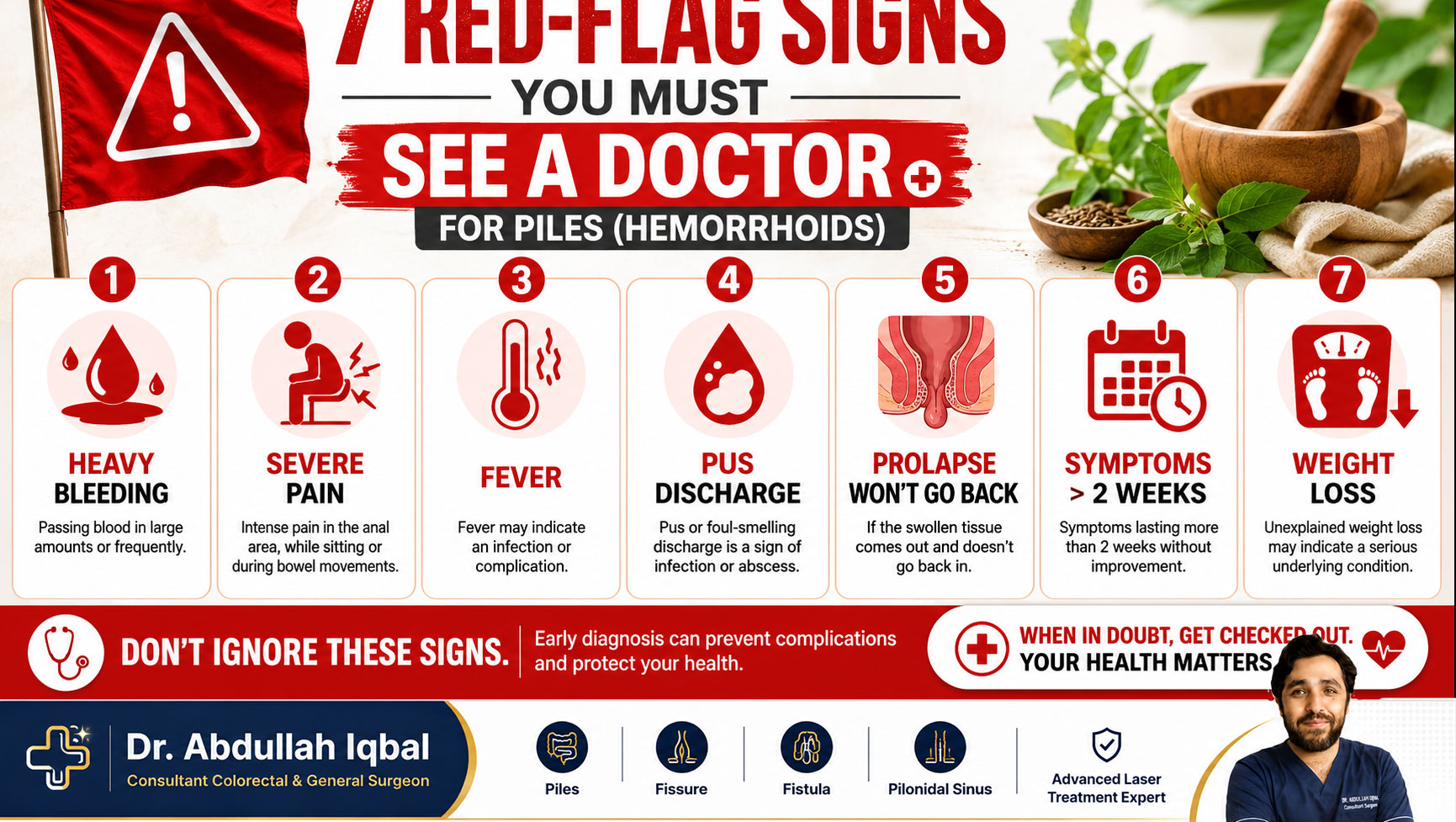
Warning Sign 1 — Any Rectal Bleeding
I will say this again and again: any rectal bleeding deserves at least one proper evaluation. Even if it is just a small amount. Even if it has happened before and resolved. Even if you think it is definitely piles.
Why? Because colorectal cancer also causes rectal bleeding. And catching it early makes all the difference in treatment outcomes. A 10-minute examination by a specialist either confirms piles or identifies something else that needs attention. There is no downside to getting checked.
Warning Sign 2 — A Lump That Does Not Go Away
External piles sometimes swell and reduce on their own. But a lump that has been there for weeks and is not changing — please get that examined. Especially if it is getting bigger, more painful, or changing color to dark purple or black.
A dark blue or black external pile usually means thrombosis — a blood clot inside. This is very painful and needs prompt treatment, ideally within 72 hours for best results.
Warning Sign 3 — Something Prolapsing Out
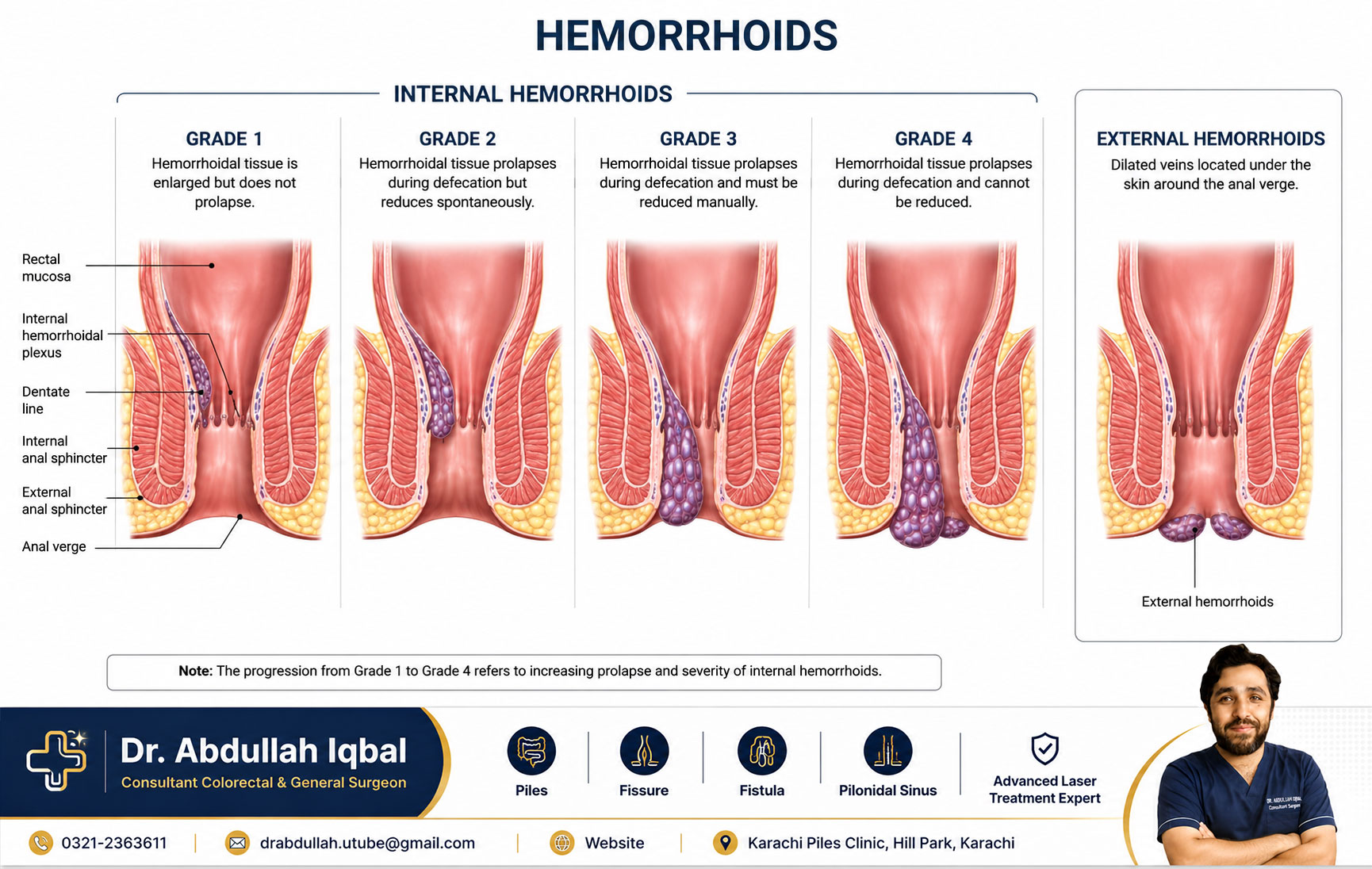
If you feel something coming out during bowel movements — and especially if you have to push it back in — that is Grade 3 piles. This does not resolve without treatment. Please do not keep pushing it back in for months hoping it will fix itself. It will not. Come see me.
Kya aap bhi haath se andar karte hain? Kitne arse se? Yeh ek bahut common situation hai lekin people hide it out of embarrassment. Aap akele nahi hain — aur yeh theek ho sakta hai.
Warning Sign 4 — Pain That Disrupts Normal Life
Mild discomfort after bowel movements is one thing. Pain that makes you dread going to the bathroom, affects your sleep, makes it hard to sit at work — that level of pain needs medical attention. Do not accept severe anal pain as normal.
In my experience, this level of pain usually means either a thrombosed external hemorrhoid, an anal fissure, or a perianal abscess — all of which benefit significantly from prompt treatment.
Warning Sign 5 — Symptoms Not Improving After 2 Weeks
If you have started dietary changes, increased fiber, increased water, and avoided straining — and after 2 weeks there is no improvement — you need professional help. Conservative management works for Grade 1 and early Grade 2. If it is not working, your grade is probably higher than you think, or there is something else going on.
Warning Sign 6 — You Are Over 45 With New Symptoms
Colorectal cancer becomes more common after 45. New rectal bleeding in this age group should always be investigated, not assumed. A colonoscopy may be recommended alongside the piles evaluation. I always discuss this openly with patients in this age range.
Warning Sign 7 — Fever With Anal Symptoms
Fever combined with anal pain and swelling usually means a perianal abscess — a collection of pus near the anus. This is an urgent condition. It does not resolve on its own. Drainage is needed, usually within 24-48 hours. Do not take antibiotics alone and hope it resolves — it typically does not.
What Happens at the First Appointment?
I want to address this because I know hesitation about what will happen stops many people from coming. Here is what a typical first visit at Karachi Piles Clinic looks like:
You come in, tell me your symptoms. I ask relevant history questions. Then a brief physical examination — external inspection and digital rectal examination, and often a proctoscopy (a small instrument to view inside). The whole thing takes 10-15 minutes. It is not painful. It is dignified. And it gives you a clear diagnosis and treatment plan.
That is it. No drama, no embarrassment. Just clarity.
Frequently Asked Questions
Piles mein doctor se kab milna chahiye?
Any rectal bleeding, a lump that does not resolve, prolapsing tissue, pain that affects daily life, or symptoms not improving after 2 weeks of conservative management — all warrant a doctor visit.
Piles ka ilaj ghar par kitne din karein phir doctor ke paas jayein?
2 weeks of dietary changes and conservative management is reasonable before seeking medical help for mild symptoms. But any bleeding should be evaluated promptly — do not wait 2 weeks for bleeding.
Piles which doctor to consult?
A proctologist or colorectal surgeon specializes in this area. Dr. Abdullah Iqbal — MBBS, FCPS, Pakistan’s first laser proctologist — at Karachi Piles Clinic is a specialist in piles, fissure, fistula and pilonidal sinus.
Kya piles doctor se milna embarrassing hai?
Bilkul nahi. Proctologists deal with this every single day. At Karachi Piles Clinic, we see dozens of such patients weekly. The examination is professional, dignified, and confidential. Your health matters more than any hesitation.
Emergency mein kahan jayein for piles?
For severe pain, heavy bleeding, or fever with anal swelling — go to Aga Khan Hospital or Liaquat National Hospital emergency in Karachi, or contact Karachi Piles Clinic for urgent appointment next morning.
If any of these warning signs apply to you right now — please do not wait any longer. Book an appointment at Karachi Piles Clinic or contact us here. Also read about whether piles can cause cancer and piles grades to understand your situation better.
Related reading
- Piles Mein Kya Khayen — Best Foods Jo Bawaseer Mein Faida Dete Hain
- Anal Bleeding: 6 Asal Wajahen Jo Aapko Pata Hona Zaruri Hai
- Sitz Bath for Piles — Kaise Karein Aur Kitna Faida Hota Hai?
- Bawaseer Ki Alamat Aur Wajuhat Kya Hain — Aur Inhe Kaise Pehchanen?
- Difference Between Piles, Fissure and Fistula — Complete Comparison
- Dr. Abdullah Iqbal, laser proctologist
- Anal fissure laser treatment
- Fistula treatment
- Contact Karachi Piles Clinic

- Fissure Cream vs Laser Treatment — Which One Actually Works? - June 29, 2026
- Fissure During Pregnancy — Safe Treatment Options and What to Avoid - June 22, 2026
- Going to the Washroom with Fissure — 7 Tips That Actually Reduce Pain - June 15, 2026
